
When All Else Is Out of Bounds, Zap Labor
From Nixon’s wage controls to today’s interest rate hikes, the fight against inflation has targeted labor.
The Trump administration says its new tariffs are aimed at combating forced labor. But the countries with the highest rates of modern slavery are largely exempt, while countries with the lowest rates are being hit with tariffs. So what are the tariffs really targeting?

The Trump administration has deployed tariffs, the most beautiful word in the dictionary according to President Donald Trump, to combat the scourge of forced labor in the global economy. But their stated concern about forced labor is nothing other than a cynical device that allows their administration to continue their policies that will make working conditions, including forced labor, in the global economy yet worse. Here’s how it happened.
When the Trump administration's temporary six month tariffs expired on the morning of July 24, 2026, President Donald Trump announced yet another round of tariffs. He used the 1974 Trade Act to impose tariffs on imports from countries that used unfair trade practices that burdened the U.S. economy. The Trump administration alleged that the countries targeted by this round of tariffs had gained an unfair trade advantage by failing to ban imports made with forced labor. The International Labor Organization (ILO) defines forced labor as any work exacted from a person under “the menace of any penalty” in which the person’s labor has not been “offered voluntarily.” The Trump administration argued that the failure of these economies to prohibit imports made with forced labor constituted an unfair trade practice that burdened U.S. commerce. Trump consequently imposed tariffs of 10% or 12.5% on imports from the European Union and 60 countries.
Trump’s tariffs, however, failed to conform to any reasonable reading of the 1974 Trade Act. The act stipulates that the Office of the U.S. Trade Representative must conduct an investigation and make sure that whatever tariffs are imposed are “the equivalent in value to the burden” that the offending country imposes on U.S. commerce. The Trump administration effectively ignored these provisions.
Public Citizen, a consumer advocacy group, reports that while “serious investigations of unfair trade practices of even just one jurisdiction usually take between five and 18 months,” the Trump administration completed its investigation of the labor practices of the European Union and 60 additional countries in a little over two months. Nor is there any indication that the tariffs Trump imposed on these countries are calibrated to the burden that their failure to ban imports made with forced labor places on U.S. commerce. On top of that, there is no evidence that those failures gave these countries any competitive advantage in the first place.
But to understand how little these tariffs are likely to do to reduce the scourge of forced labor and root out modern slavery, it is necessary to look more closely at where those tariffs fall in the global economy.
A recent fact sheet published by the Office of the U.S. Trade Representative claims that, with the July tariffs, “the United States is setting high standards for protecting workers at home and abroad by taking tough action to root out modern slavery from global supply chains.”
But let’s get a few things straight. Trump’s tariffs target countries that have failed to ban imports of goods allegedly made with forced labor—not countries that have failed to prohibit forced labor within their own borders. And many of the countries where forced labor is most prevalent and working conditions are most dire are not subject to the tariffs.
The Modern Slavery Index, compiled by Walk Free and the Labor Rights Index of the International Trade Union Confederation, make that clear. Walk Free’s count of people in modern slavery includes not only forced labor but also forced or servile marriage, debt bondage, forced commercial sexual exploitation, human trafficking, the sale and exploitation of children, and other slavery-like practices. The Labor Rights Index is based on the ILO’s core labor standards, including the ILO convention on forced labor, and covers five broad areas: civil liberties; the right to establish and join unions; trade union activities, the right to collective bargaining; and the right to strike.
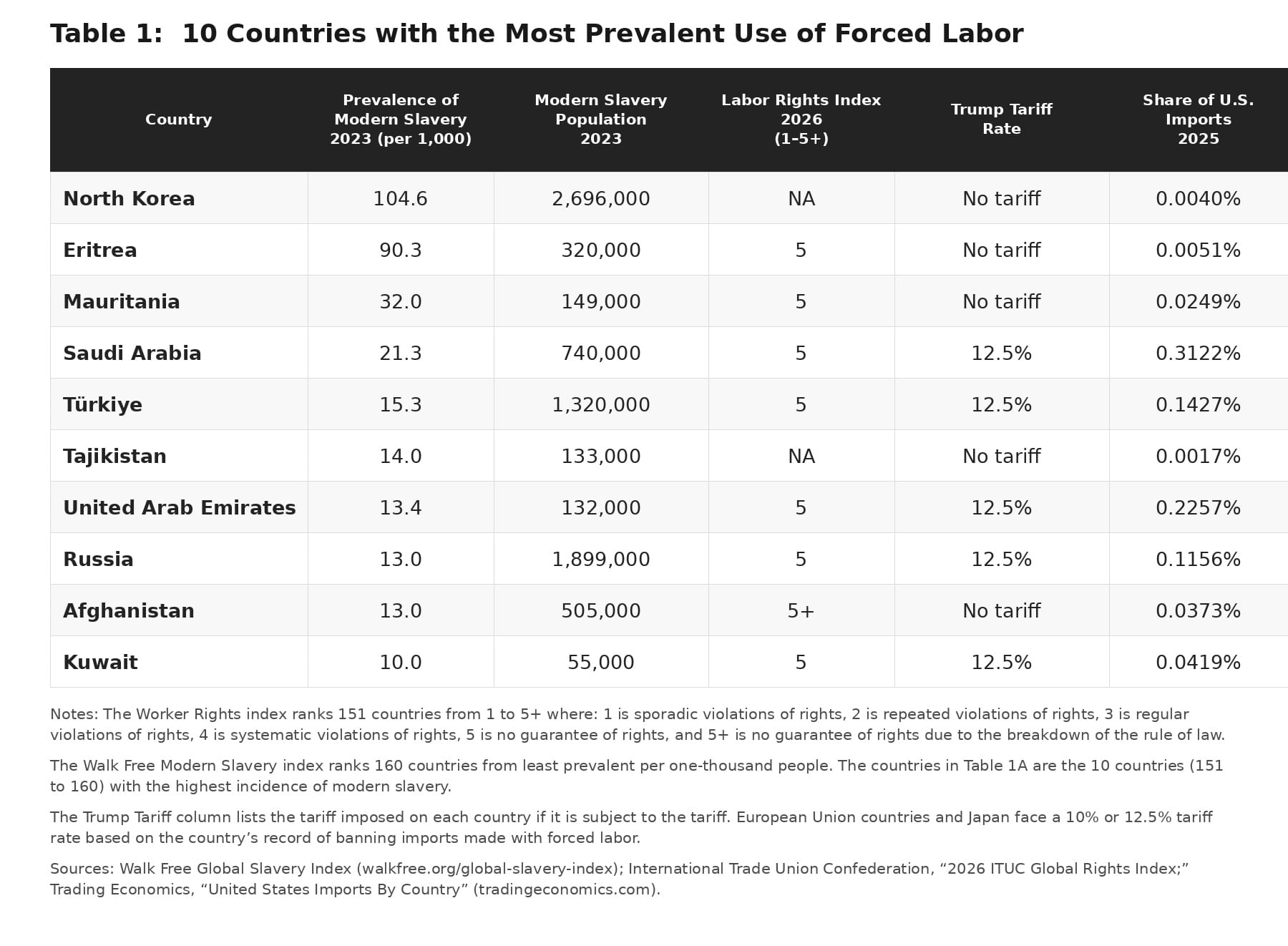
The two tables below show that the Trump’s tariffs have little to do with combatting modern slavery or the violation of workers’ rights, including forced labor. The first table (Table 1) covers the 10 countries with the highest incidence of modern slavery. No tariff is levied on fully half of those 10 countries. Some 3.8 million people in those five countries are modern slaves. Also, the average number of modern slaves per 1,000 people in these 10 countries runs from a low of 10 to a high of 104.6. On top of that, the Labor Rights Index for each of these countries (when available) is at least a five—meaning that workers have “effectively no access” to whatever labor rights are spelled out in legislation. The only rating worse than a five is a five-plus, which indicates “the breakdown of the rule of law.”
The second table (Table 2) covers the 10 countries with the lowest incidence of modern slavery. In those 10 countries the total number of modern slaves is 238,000, just 3.0% of the total for the 10 worst countries. Nonetheless, every one of these countries are subject to the Trump tariffs. In addition, the average number of modern slaves per 1,000 people in these countries ranges from a low 0.6 to a high of 1.4. Also, six of the countries have a workers’ rights rating of one—sporadic violations of rights where “collective labor rights are generally guaranteed”—the most favorable rating.
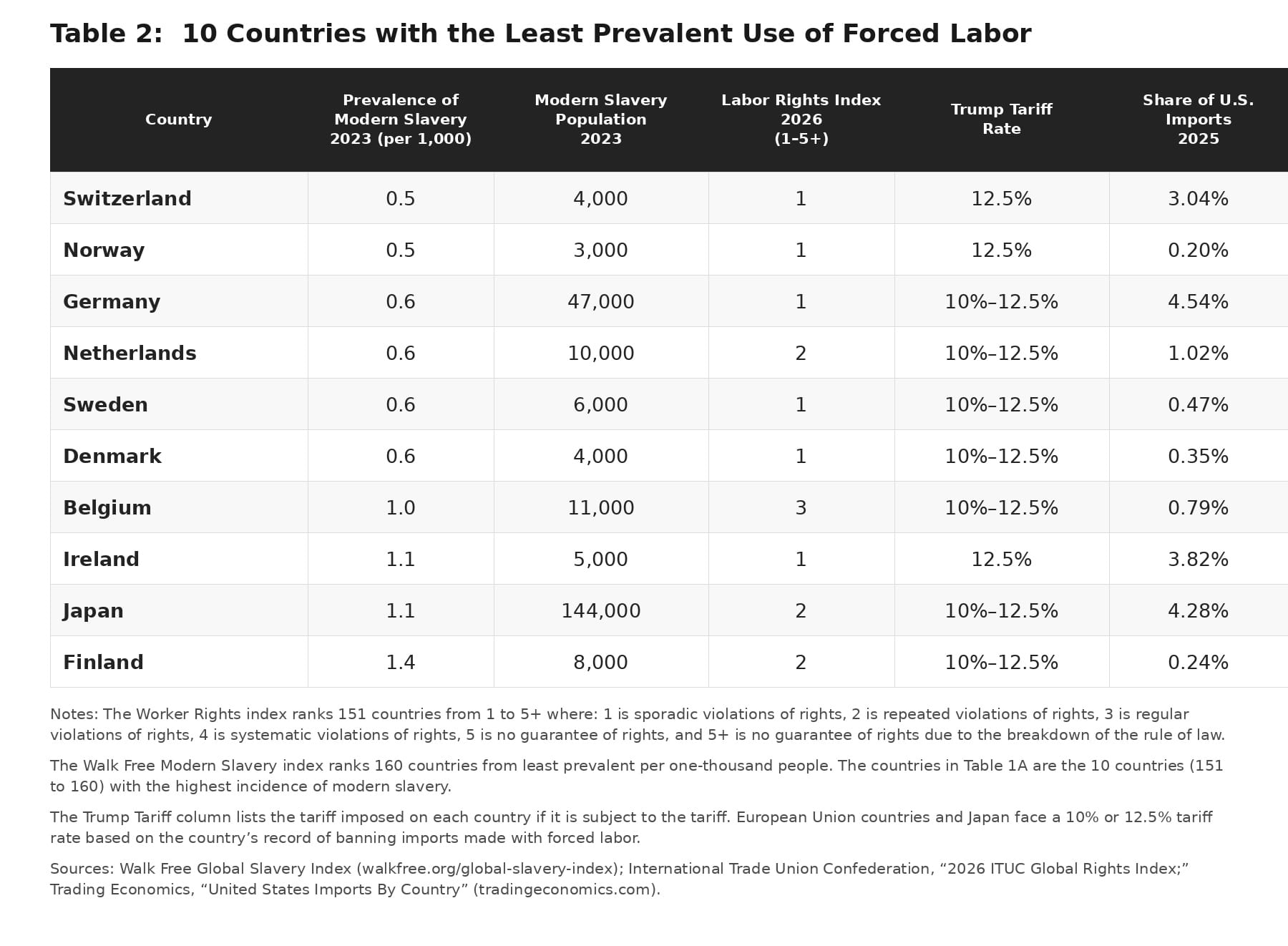
The Swiss government immediately objected to the new tariffs, which were applied to Swiss imports at rates of up to 12.5%. Its objection is understandable: Switzerland’s labor rights record is far superior to that of the United States. In Switzerland there are 0.6 modern slaves per 1,000 people and its workers’ rights index rating is one. In the United States there are 3.3 modern slaves per 1,000 people and its workers’ rights index is four, indicating “repeated violations of rights.” In addition, the business-sector lobbying group Economiesuisse told the Wall Street Journal that, “There is no evidence that Swiss supply chains are being used to smuggle goods produced through forced labor into the U.S. market.”
So, what determines whether a country is subject to U.S. forced-labor tariffs? In practice, the answer appears to be how much it sells to the United States. The 10 countries with the strongest records of combatting modern slavery, all of which are subject to the forced-labor tariff, account for a total of 18.75% of U.S. imports. But the 10 countries with the weakest records account just 0.91% of U.S. imports, while the five countries not subject to the Trump tariff account for just 0.07% of U.S. imports. Taken together, the European Union and 60 economies targeted by the tariffs account for 99.4% of U.S. imports.
The administration’s record on protecting workers at home is no more consistent with its stated concern about forced labor abroad. The number of U.S. Department of Labor wage-and-hour investigators in 2025 was less than half of the number of inspectors in 1978, while the number of establishments covered by each investigator has more than tripled. On top of that, the budget for Immigration and Customs Enforcement’s Enforcement and Removal Operations has grown by leaps and bounds, while funding for enforcement by the Labor Department’s Wage and Hour Division has remained essentially flat.
Public Citizen also reports that U.S. Customs and Border Protection has failed to adequately enforce the Forced Labor Prevention Act, which bars imports made with forced labor in the Xinjiang Uyghur Autonomous Region. The agency has also lifted the ban on sugar produced by the Dominican Republic’s Central Romana Corporation, which had been cited for systematic forced labor. Meanwhile, DOGE cuts to Department of Labor programs have reduced the agency’s capacity to promote labor standards globally.
In announcing the tariffs, the U.S. Trade Representative said that “taking action against forced labor and modern-day slavery” in the global supply chain is long overdue. But the Trump administration’s actions, cloaked in a hypocritical concern about workers’ rights, have made things worse, not better.
John Miller is a professor emeritus of economics at Wheaton College and a member of the Dollars & Sense collective.

From Nixon’s wage controls to today’s interest rate hikes, the fight against inflation has targeted labor.

The Political Economy Research Institute’s new initiative brings together economists and practitioners to develop transformative but practical policies for a fairer, greener, and more democratic economy.


Low Total Compensation Syndrome. It's not you. It's the economy—a silent epidemic affecting at least 51% of the population.