In Review: Book Reviews from Dollars & Sense
Note: Not all reviews are available online.
Order back issues here.
Subscribe to the print or electronic editions.
Donate to support our work.
-
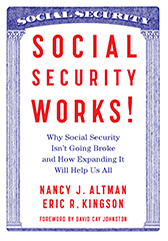
A review of Social Security Works! Why Social Security Isn’t Going Broke and How Expanding It Will Help Us All by Nancy J. Altman and Eric R. Kingston, with a foreword by David Cay Johnston (New Press, 2015).
The American public has also been of two minds regarding Social Security; they worry about the program going bankrupt, but also favor expanding it.
Social Security Works! makes a strong case for expanding Social Security. Its authors worked on the Greenspan Commission in the early 1980s (Altman was Alan Greenspan’s assistant). In this book, however,they criticize the Commission report, ...Read more »
-

A review of Other People’s Houses: How Decades of Bailouts, Captive Regulators, and Toxic Bankers Made Home Mortgages a Thrilling Business by Jennifer Taub. Yale University Press, 2014.
Jennifer Taub, a professor at the Vermont Law School, focuses on what she knows best—the regulatory and legal issues that impact financial institutions and lending. She also weaves a good deal of history and economics into her story about how the American Dream of homeownership was killed. Her book demonstrates that ...Read more »
-
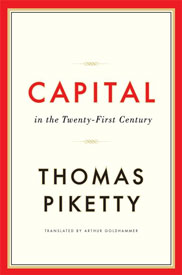
A review of Capitalism in the Twenty-First Centuryby Thomas Picketty. Harvard University Press, 2014.
Given decades of rising inequality and its negative consequences (see The Spirit Level by Richard Wilkinson and Kate Pickett and my review in the May/June 2010 issue of Dollars & Sense) and public concern about a disappearing middle class, this book is particularly timely. It relies on a wide array of data, collected by the author, showing long-term trends in income and wealth distribution. It explains the causes of these trends and ends by setting forth some bold policy solutions.
Still, the most important aspect of Capital in the Twenty-First Century is ...Read more »
-
A review of Social Democratic Americaby Lane Kenworthy. Oxford University Press, 2014.
Lane Kenworthy makes a strong case that we don’t need to reinvent the wheel to improve public policy. The United States can replicate successful programs employed elsewhere and fund them by eliminating ineffective policies. While government spending in the United States is proportionately much less than in Nordic nations, adding “tax expenditures” (deductions for things like mortgage interest) makes U.S. government spending close to levels in Norway.
Because much U.S. government spending occurs through the tax system, it mainly benefits the wealthy and remains hidden. For example, ...Read more »
-
A review of The Public Bank Solution: From Austerity to Prosperityby Ellen Brown. Third Millenium Press, 2013.
Ellen Brown is an attorney by training and President of the Public Banking Institute. The Public Bank Solution argues that problems with the banking industry stem from the nature of private banking and that public banks will solve these problems—by investing in infrastructure and by lending when private banks will not. The first case is easy to make; the latter case is more difficult.
The book begins with an excellent history of money and banks; it then moves to modern times by detailing the rise of central banking, ...Read more »
-
A review of The Price of Inequality: How Today’s Divided Society Endangers Our Future,
by Joseph Stiglitz. W.W. Norton, 2012.Shifting 5% of national income from the middle and bottom to those at the very top, who will save more of it, Stiglitz argues, reduces economic growth by around 2 percentage points annually. When productivity is a team effort, and some team members are paid enormously more than others, efficiency suffers, since people are unwilling to work hard to enrich someone else. Efficiency also takes a hit since, ...Read more »
-
The Poverty of Anti-Poverty Policy
A review of So Rich, So Poor: Why It's So Hard to End Poverty in America, by Peter Edelman. (The New Press, 2012.).
He served as an aide to Sen. Robert Kennedy while Kennedy was developing an anti-poverty agenda for the United States. During the Clinton administration,
Edelman was an assistant secretary in the Department of Health and Human Services. His superb 2006 book, Reconnecting Disadvantaged Young Men (written with Harry Holzer and Paul Offner), advocated several policies to increase earnings for less-educated and less-skilled young men.
In an act of enormous political courage, Edelman resigned in protest when President Clinton signed the bill ending the main U.S. welfare program, Aid to Families with Dependent Children (AFDC), and replacing it with Temporary Assistance to Needy Families (TANF). He then went public in The Atlantic Monthly, explaining the many negative effects of "ending welfare as we know it". So Rich, So Poor explains why poverty is so high in the United States and what we can do... Read more »
-
How Big Companies Use “Plain English” to Rob You Blind
A review of The Nickling and Diming of America, by David Cay Johnston. (Portfolio/Penguin, 2012.).
Like all good story collections, a single theme prevails. The preface captures it well. Johnston's mother took him to a baseball game in the 1950s. Imagine, she said, if everyone in the stadium gave you a nickel. Johnston calculated he would have reaped over 1,000 dollars (8,800 in today's dollars). His mother next tried to get Johnston to figure out how ... Read more »
-

A review of Caring for America: Home Health Workers in the Shadow of the Welfare State, by Eileen Boris and Jennifer Klein. (Oxford University Press, 2012.).
In other states, where funding has been reduced and direct-care jobs have been curtailed or eliminated, low-income Americans have suffered both as workers and clients.... Read more »
A review of End This Depression Now!, by Paul Krugman (W.W. Norton, 2012.).
End This Depression Now!, as Krugman freely admits, contains little that will be new to followers of his blog and his Times column. It pulls together and fleshes out many previous arguments. Its broader goal is to influence public opinion and to persuade policymakers to adopt more expansionary economic policies. A worthwhile endeavor indeed!
As we enter the sixth year of our current slump, U.S. unemployment still exceeds 8%. Brief sightings of substantial economic improvement invariably turn out to be mirages. Austerity has become fashionable throughout the world. Policymakers focus on controlling inflation, restoring business confidence, and cutting budget deficits rather than dealing with high unemployment.... Read more »
A review of Debt: The First 5,000 Years, by David Graeber (Melville House, 2011).
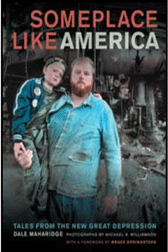
A review of Someplace Like America: Tales from the New Great Depression. By Dale Maharidge, with photographs by Michael S. Williamson and a foreword by Bruce Springsteen. University of California Press, 2011.
Someplace Like America documents the consequences of a 30-year war against average Americans. It is a powerful story of the abandonment of the American worker.
Dale Maharidge began interviewing the unemployed during the early-1980s recession. With photographer Michael Williamson, he spent time in Youngstown, Ohio, documenting its decline after the steel mills closed. They also rode the rails with hobos and interviewed homeless families living in tents throughout America. He likened their experiences to the Joads in John Steinbeck’s novel The Grapes of Wrath after their Oklahoma home was foreclosed on, and they headed west in search of work and the American Dream. ... Read more »
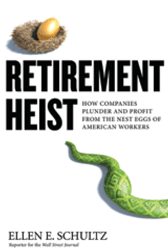
Review of Retirement Heist by Ellen E. Schultz. Portfolio/Penguin, 2011.
Ellen Schultz has covered corporate pensions for the Journal since 1990. Retirement Heist replicates and extends her award-winning reportage.
The retirement crisis, as Schultz points out, has nothing to do with an aging population or poor returns on employee pension funds. Rather, the real problem is that corporations have plundered worker pensions to improve their bottom line, increase company stock prices, and boost executive pay.
In case after case, Schultz documents the many ways corporations have cut retirement benefits and movingly describes their consequences. The result is a tale of worker abuse by the top .1% (yes, Occupy Wall Street forgot the decimal point)..... Read more »
-

A review of Kids First: Five Big Ideas for Transforming Children’s Lives and America’s Future, by David Kirp (New York: Public Affairs, 2011).
Each approach has strengths and weaknesses. Hedgehogs are relentless but not sufficiently diversified. Like Bill Murray in the movie "Groundhog Day," they attempt one thing over and over again until it (hopefully) gets done. The cunning fox devises many strategies to get what it wants and then demands that we do something to achieve that end but fails to prioritize its preferences.
For a number of years, University of California-Berkeley public policy professor David Kirp has focused on the high rate of child poverty in the United States—more than double that of other developed countries, according to Luxembourg Income Study data. In his excellent 2007 book The Sandbox Investment, Kirp was a hedgehog, pushing pre-school education as the strategy of choice for reducing... Read more »
-
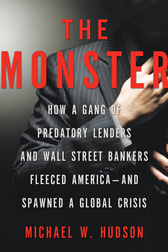
A review of The Monster: How a Gang of Predatory Lenders and Wall Street Bankers Fleeced America—and Spawned a Global Crisis by Michael W. Hudson. (New York: Times Books, 2010.)
In The Monster, Hudson’s highly readable new book, victims are again present, with many compelling vignettes of people who were deceived or pressured (or both) into signing up for harmful high-cost loans. But his main focus this time is on the lenders. The heart of his book is based on interviews with scores of former employees, most of whom left the industry in disgust over the ways that they were forced to take advantage of people if they wanted to keep their jobs.
Hudson (not to be confused with the economist of the same name who.... Read more »
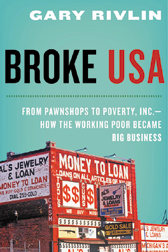
A review of Broke, USA by Gary Rivlin (New York: HarperCollins, 2010).
Their stories come from dozens of interviews conducted by the author and revolve around six industries—check-cashing outlets, rent-to-own shops, pawnbrokers, payday loan stores, tax preparers offering tax refund advances, and subprime mortgage lenders. Collectively, these industries make $150 billion in revenue per year; an average low-income family spends $3,800 annually on their services, around 15% of its meager income.
Many of the individual stories are gripping and reveal the inner workings of businesses that lend to the poor. They clearly show how the enormous rewards from predatory lending inevitably lead to exploitation of the poor. ... Read more »
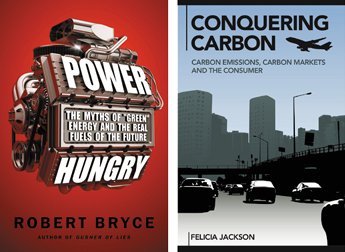
A review of Power Hungry by Robert Bryce (New York: PublicAffairs, 2010) and Conquering Carbon by Felicia Jackson (London: New Holland Publishers, 2009).
The two books under review here take very different approaches to this problem. One argues for natural gas and nuclear energy to support America’s appetite for power, the other for limiting energy consumption and carbon emissions using pollution permits.
Power Hungry is a frustrating book. Its tone constantly shifts from scholarly to glib. ... Read more »
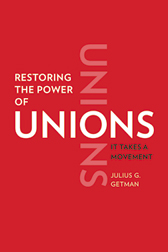
The Fall and Rise of Hotel Worker Unionism
A review of Restoring the Power of Unions: It Takes A Movement by Julius Getman (New Haven, Yale University Press, 2010).
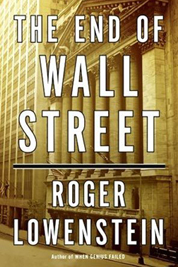
The Underpants Gnomes of Wall Street
A review of The End of Wall Street by Roger Lowenstein (New York: Penguin Books, 2010).
As we gain perspective on the greatest financial crisis since the Great Depression, store shelves abound with books seeking to explain how bankers have morphed from the conservative and prudent gnomes of Swiss legend to the underpants gnomes of South Park.
Roger Lowenstein’s contribution is good, but somewhat disappointing, especially given that his book on the rise and fall of Long Term Capital Management, When Genius Failed, has deservedly become the classic account of that episode of financial folly. He writes too little about the outright fraud committed by financial institutions, and there is nothing on the human suffering from foreclosures, unemployment, or the decimation of communities ... Read more »
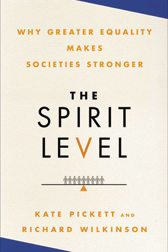
A review of The Spirit Level by Richard Wilkinson and Kate Pickett (New York: Bloomsbury Press, 2010).
To my professional embarrassment, most economists pay scant attention to income inequality. They see each person’s income as an appropriate reward for their productive activity. They even view income inequality as healthy because it creates incentives for people to innovate, work hard, and produce more. On the other hand, government programs that seek to reduce inequality, and the progressive taxes that support them, are viewed as disincentives for citizens to be productive and successful. ... Read more »
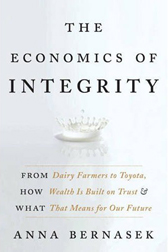
A review of The Economics of Integrity by Anna Bernasek (HarperCollins, 2010).
John Kenneth Galbraith described his insecurities surrounding publication of The Affluent Society: “I feared it would be dismissed as another semi-socialist case for public spending.... Then in the autumn of 1957, the Soviets sent up the first Sputnik. No action was ever so admirably timed. ... I knew the book was home.”
Unfortunately, The Economics of Integrity appears amidst reports of serious defects with the brakes, accelerator pedals, and electrical system on millions of Toyotas. Since Toyota figures prominently in this book, it is likely that it will be dismissed as another case for ethical behavior. This would be too bad, because this is a very good book.
Bernasek astutely notes that economists ignore cooperation and focus mainly on choices made by individuals to enhance their own welfare. ... Read more »
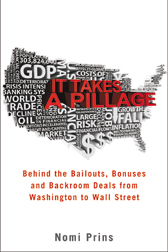
Pillaging Villains of the Financial Crisis
A review of It Takes a Pillage: Behind the Bailouts, Bonuses and Back-room Deals from Washington to Wall Street by Nomi Prins (John Wiley & Sons, 2009).
Near the top of my list, and Prins’, is Hank Paulson, CEO of Goldman Sachs before being made Treasury Secretary by President Bush.
At Goldman and the Treasury, Paulson pushed for deregulating U.S. financial institutions. As late as the summer of 2008, he insisted that bailing out financial institutions was always a bad idea. And, oh yes, Paulson was the one who let Lehman go belly up.
Then he had a change of heart. He pressed Congress for money to bail out large financial institutions. He arranged the deal that let Bank of America buy Merrill Lynch. On the last day of the Bush administration, he gave $20 billion in TARP money to Bank of America. ... Read more »