U.S. Banks and the Dirty Money Empire
Reprising a classic article by radical sociologist James Petras, who died on January 17th, 2026.
The Jobs Report from the National Jobs for All Network

There was not much change from December in many of the January numbers in the Bureau of Labor Statistics’ Unemployment Situation for January, or in the National Jobs for All Network’s estimation of total real unemployment. Some groups experienced slight improvements. In the government report, the unemployment rate was down a notch from 4.4% to 4.3%. Rates for Hispanics, African-Americans, and teens fell a couple of tenths, and we want that to continue. The black unemployment rate, for example, is still twice the white rate. Overall, non-farm jobs increased, adding 130,000 people. That’s after months of weak job growth.
Hidden unemployment fell from 11.5 million people to 10.7 million. Another small plus. But there were still 18 million truly unemployed. That’s equal to the population of the Netherlands; and that is a lot of people even for a big country like ours. Meanwhile, in line with slight improvements in the unemployment numbers, the level of initial claims for unemployment benefits has fallen. Four-week averages have generally been a little lower in recent months than they were in much of 2025.
Among other important indicators, real wages are barely moving. Average hourly real pay for rank-and-file employees increased 1.5% over the last year. Better than nothing but not worth much applause. For another important number, there is no improvement at all and there won’t be in the future. Manufacturing jobs are not “coming back.” Trump’s tariffs, which were going to fix the trade deficit and promote American production, did not reduce the trade deficit at all. By the end of 2025 it was about where it was in 2024. Manufacturing jobs have been sliding since 2023. Roughly 300,000 were lost. There is zero likelihood that anything significant or realistic will be done at the national level to increase factory jobs. And more AI will probably make things worse.
Jobless Booms and Boomless Times
It turns out that the catchy phrase we used to describe what was happening to jobs in late 2025 needs revision. Economic growth was thought to be strong—hence, a prominent economist coined the phrase “jobless boom.” But we had not gotten the data on fourth-quarter growth. The second and third quarters of last year did show strong economic growth—we can call them boom quarters. But it turns out that growth in the fourth quarter was a dud—just 1.4%. So weak job growth in the last months of the year matched weak economic growth. Not a jobless boom, but an almost jobless, boomless period.
Deep Stuff
What explains the persistence of high levels of unemployment and hidden unemployment all the time, even as the economy grows strongly or weakly or not at all? Well, gosh, the capitalist system works best for those who own and run it if there is always plenty of wage-depressing unemployment. That’s normal. What is not normal is that things may soon get much worse. There is a monster out there that will destroy millions of jobs just as automation and other technologies destroyed millions of jobs in the past. That monster is called Artificial Intelligence.
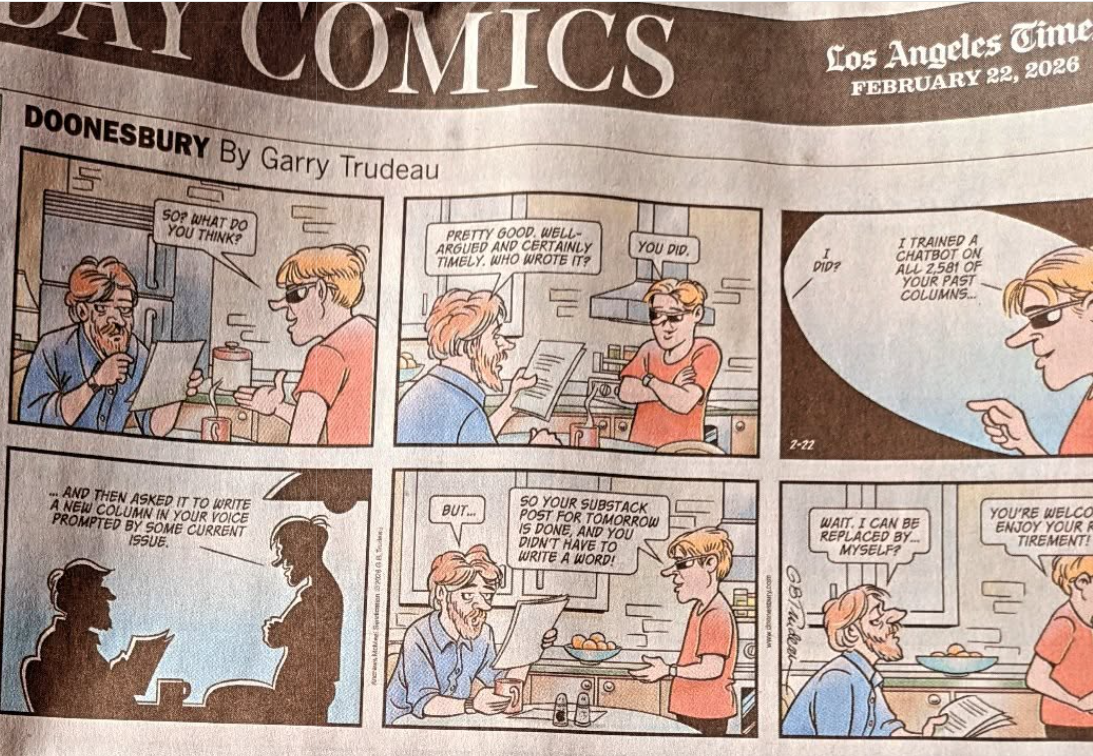
Others know much more about AI than I do, but of several ways that AI works, certainly a key one is to eliminate employees in many kinds of positions, including coding and programing, and cartooning too. AI can learn and so it can fix itself. (Another marvelous AI utility is to enhance people’s capacity for evil. Recently, a company called CiviClick used AI to create thousands of fake negative public comments on the proposal of the Southern California pollution board to phase out gas-powered appliances.)
AI is still partly in the building phase, so there must be some job-creation benefits from the construction of battery parks, water-cooling sites, and electricity generation facilities. But that positive impact will soon pale alongside the fundamental goal of AI: job destruction. Is this already happening in a significant way? And is that why we do have quarters of strong economic growth without strong job growth, as in the third quarter of last year? Is it, for example, significant that monthly hiring rates have been lower in 2024-25 than earlier periods. They now average around 3.4% (as a percentage of the employed labor force). They were often 3.8% to 3.9% in 2018-19. As I suggested last month, we are not in a low-hire economy in any absolute sense—not when there are 5 million hires a month. But hiring percentages and totals are down by several hundred thousand a month in recent years. That’s ominous.
And that is just the beginning of what AI may do to job numbers. In his February 10, 2026 Atlantic Monthly article, “America Isn’t Ready For What AI Will Do To Jobs,” Josh Tyrangiel and some of his sources are convinced that there is an AI job catastrophe coming soon. The Captains of the Tech Industry don’t want to talk about it. A relative handful of political figures are speaking out on the issue. They include Bernie Sanders who has a legislative program that includes shorter hours and a robot tax on tech businesses. There is Steve Bannon, who wants to get good people on tech boards. Author Tyrangiel wants the government to have a better idea of what is happening to jobs by expanding the BLS’s too small household sample from 60,000 households and adding a supplement on AI usage. Good ideas, but no substitute for a major government response to the coming catastrophe Tyrangiel has described. Won’t there still be plenty of important jobs not being done? Can’t a good government create them?
Three Final Notes
First, What about those layoffs at WAPO and elsewhere? There was a hullabaloo a couple of weeks ago about highly publicized layoffs at Amazon and other companies. One revealer was the business consulting firm of Challenger et al. We do not know if those layoffs had anything to do with broader trends. The BLS layoff numbers for January are late and those for February aren’t due yet. We should cross our scholarly fingers and hope that we get both sets in mid-March.
Second, What happens to consumption spending if many millions more are without decent jobs? Consumption is a large share of the spending that makes the economy grow.
Third, What happens to identity and authorship if A.I. can write as well as F.S.? If we are still around in, say, February 2031, you, dear reader, may ask if the monthly unemployment essay was written by A.I. or F. S. And I might still know the answer. (Thanks for an idea to Garry Trudeau, in the Los Angeles Times, February 22, 2026.)