
Unemployment as Policy: Federal Layoffs, AI, and Corporate Understaffing
The Jobs Report from the National Jobs for All Network
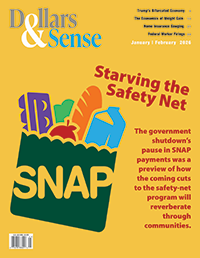
The government shutdown’s pause in SNAP payments was a preview of how the coming cuts to the safety-net program will reverberate through communities.

At the start of November, while the government was shut down due to a lapse in federal appropriations, millions of families across the United States abruptly lost access to food assistance.
For the first time since the creation of the Supplemental Nutrition Assistance Program (SNAP, commonly called “food stamps”) in the 1960s, the federal government chose not to fund benefits during a shutdown. The Trump administration broke with decades of precedent, followed by both Democratic and Republican administrations, by allowing the nation’s largest anti-hunger program to grind to a halt.
By late October, the U.S. Department of Agriculture website carried a blunt message: “[T]he well has run dry … there will be no benefits issued.”
As the administration resisted federal rulings to fund the program, grocery store workers had to explain to distressed and confused shoppers why their Electronic Benefit Transfer (EBT) cards, which provide access to SNAP benefits, hadn’t been reloaded with the new month’s funds.
Meanwhile, food banks and pantries across the country scrambled to fill the gap for people in need. Families seeking food lined up for hours in big cities and small towns alike, while volunteers frantically loaded boxes and bags with free canned goods and pantry staples. For nearly two weeks—before the shutdown ended on November 12—this patchwork of assistance became the only safety net for people cut off from the food benefits they’d relied on.
Temporary as it was, the November SNAP freeze offered a glimpse of what may soon unfold more slowly and unevenly under the Trump administration.
Months before the government shutdown, Congress had already altered the future of SNAP. The One Big Beautiful Bill—the sweeping Republican tax-and-spending package signed into law last summer—dismantles the program in less visible but more permanent ways.
By shifting SNAP costs to states and restricting benefits, the new law lays the groundwork for a quiet transformation of the U.S. food system—an economy, from farms to independent grocers, that is far more reliant on SNAP than policymakers may realize.
“Food is such a critical part of the economy,” said Holly Parker, chief strategy and program officer at Michigan-based Fair Food Network. When SNAP is disrupted, she said, “it doesn’t just affect the families that use SNAP for grocery shopping—it also ripples out quite quickly to groceries, large and small markets, corner stores, farmers, and communities.”
SNAP’s most basic function is to help low-income families afford groceries. But because benefits effectively operate as cash for food, SNAP does much more than lower grocery bills.
Currently, SNAP provides food benefits to roughly 42 million Americans—more than 12% of the U.S. population. Shoppers swipe their EBT cards at the grocery store—or farmers market, corner store, or any other business that meets the requirements to accept SNAP—and SNAP food benefit dollars are applied to their grocery bills. In May 2025, the average SNAP participant received about $188 in SNAP benefits each month—freeing up money in their budgets they can use on rent, health care, or other necessary expenses.
While food pantries and their donation bins may be more visible in a community, SNAP provides nine times as much food to people in need. Significant changes to the program, then—like those in the so-called One Big Beautiful Bill—have a substantial impact on hunger across the United States.
Unlike much of the U.S. social safety net, SNAP has long been a true entitlement program. Applicants need not wait on long waiting lists or be denied because a state ran out of funds, because 100% of SNAP benefits are funded at the federal level.
This is how SNAP is able to expand and contract with the economy. As an “automatic stabilizer,” as economists call it, SNAP grows when more people need help and declines as their finances improve.
As SNAP participants spend their benefits—and they do so quickly, with 80% of benefits spent within the first two weeks of receipt and 97% spent within the month—their purchases ripple through the food economy. The impact spreads from the stores where they bought their food to the manufacturers that produced it, the drivers that transported it, and the farmers that grew it.
SNAP’s ability to stimulate the economy is substantial: every $1 of SNAP benefits spent generates between $1.50 and $1.80 in economic activity—an effect that is even more prominent during economic downturns.
But the flipside is also true: Unprecedented drops in SNAP spending can upset local economies’ fragile food ecosystems, a phenomenon experienced throughout the country last fall, and which will certainly be felt when the new changes to SNAP take full effect.
The massive changes to the social safety net within the One Big Beautiful Bill, which represents the policy core of the second Trump administration’s agenda, include SNAP cuts of $187 billion over the next 10 years, according to estimates from the Congressional Budget Office.
“There [was] so much attention being put on the shutdown because this huge pocket of the population [was] going to feel it,” said Gina Plata-Nino, SNAP director at the Food Research and Action Center. The various program cuts, meanwhile, will more slowly trickle into people’s lives, she said, “to very vulnerable populations…who don’t have a lobbying arm in D.C.”
The biggest shift in the program will be who pays for it. Like many programs sent to the policy gallows (see 1996’s welfare reform), SNAP benefit funding will soon be shifted, at least in part, to the states. Rather than the federal government covering the total cost of benefits, if a state has a SNAP payment error rate above 6%, it will be responsible for part of the benefit cost. (A state’s SNAP payment error rate involves underpayments and overpayments of benefits, and isn’t related to SNAP fraud, which in any case is very rare.) If the error rate rises above 10%, a state will have to pay 15% of benefit costs—likely millions of dollars, and in some states even billions.
Since 2003, only one state (South Dakota) has never had its payment error rate rise above 6%.
Some states may be able to delay implementation of the cost share by up to two years, but otherwise the new policy will be effective in fall 2027.
Meanwhile, while states currently pay half of SNAP administrative costs, next fall they’ll have to pay 75%—a move that allows the federal government to pocket $25 billion.
With state budgets that need to be balanced each year, states facing higher SNAP costs—as well as other cost shifts introduced in the One Big Beautiful Bill, such as in Medicaid—may respond by cutting SNAP, risking the kind of program erosion that hollowed out Temporary Assistance to Needy Families after welfare reform.
Some states may even eliminate SNAP altogether.
According to an October analysis published by the Brookings Institution, the devolution of SNAP responsibility from the federal government to the states is the change to the program that will most severely weaken SNAP’s ability to fight recessions. As states pull back spending during economic downturns, some will likely move to cut or end the program entirely—a sharp contrast to SNAP responding to economic crisis by automatically expanding.
And the shift to state responsibility threatens more programs than just food assistance. “Even if a state figures it out, that means that something else was given up” to pay for it, said Plata-Nino.
Yet while new costs won’t be felt by states for another couple of years, SNAP recipients themselves are already dealing with big changes. SNAP has long included work-reporting requirements, but there are now stricter paperwork requirements surrounding reporting work—and states are limited in challenging them.
Since 1996, most SNAP recipients without children have had to report at least 20 hours of work per week to continue receiving benefits for longer than three months in a three-year period. But states were able to apply for waivers for specific areas suffering high unemployment rates. Now, however, local areas will only receive waivers if the official unemployment rate is higher than 10%, an extremely high standard meaning few areas, even among those with insufficient jobs, will be able to waive requirements.
Most SNAP recipients who can work, do work—the issue for many may simply be reporting it. Many low-income people who receive SNAP may work fluctuating hours or nontraditional jobs, and proving that they work 20 hours per week can be difficult. In the same way, SNAP recipients who are exempt from the requirement because of disabilities will need to go through the red tape of verifying it.
The work-reporting requirement is already in effect: The Congressional Budget Office estimated that more than three million people will lose SNAP benefits because of it.
The new rules also drastically restrict SNAP aid for immigrants. Since the start of November, refugees, asylees, and many other legally present immigrants are ineligible for SNAP. Plus, the new law will also reduce benefit amounts overall for many who will be able keep SNAP—changes that most households will only experience when then recertify for the program, which they do every six months or every year, depending on the state.
“These changes that are inevitably coming [were] accelerated,” during November’s funding freeze, said LaTrell Clifford Wood, a hunger policy advocate at the state-based advocacy group Alabama Arise.
When SNAP was frozen during the government shutdown, grocery store workers had front-row seats to the consequences.
One grocery worker in Michigan noticed far fewer customers in their store—and also that the customers that did come inside were spending more time in the clearance section and leaving with fewer bags.
Both the store and its workers felt the changes. The worker in Michigan said that their store lost $56,000 in one day alone in early November. To make matters worse, staff in the grocery department as well as the store’s general merchandise department had their hours cut.
Indeed, the United Food and Commercial Workers International Union (UFCW), which includes grocery store and food processing workers, sounded the alarm about the impact on food system workers during the SNAP emergency. “[F]ewer people on SNAP [means] fewer people coming to grocery stores and buying products,” said Ademola Oyefeso, director of UFCW’s legislative and political action department. “That could cause hurt to our members, whether it’s a loss of hours or a loss of jobs.”
With the cost of groceries already a sore point for many shoppers, grocery stores had to struggle with another reason that customers might avoid buying food—especially the stores that heavily rely on SNAP shoppers.
Though 12% of the population uses SNAP nationwide, some stores rely on it more than others—particularly in rural areas. Parker, based in Michigan, said that some of the Fair Food Network’s retail partners report more than 80% of their customer bases using SNAP.
“You can imagine how quickly [a program disruption] threatens the livelihoods … of the families who own and operate the grocery stores,” Parker said. “Then, when grocery stores are under threat, all the other businesses in [a] community are also more vulnerable,” she added.
Grocery stores often serve as economic anchors in their communities, attracting further businesses and development because of the reliable foot traffic that grocery stores generate. After all, as of 2022, about 82% of Americans visit a grocery store in person at least once a week.
In Colorado, a drop in SNAP spending had some markets worried about meeting rent and were even weighing closing their doors, said Daysi Sweaney, director of nutrition incentives at Nourish Colorado, which works with farmers, markets, and small grocers to support the use of SNAP.
Program incentives play a large role in supporting stores and farmers, Sweaney explained. For example, Colorado’s Double Up Food Bucks program allows SNAP recipients to receive matching funds, up to $20 a day, to effectively double their purchases of fresh fruits and vegetables—a healthy food incentive that directly supports retailers, especially farms and farmers markets.
“Farmers like me will see that revenue stream shrink and we’ll lose some of our favorite customers,” a Colorado farm owner told Nourish Colorado after the One Big Beautiful Bill passed.
During the November SNAP stoppage in Pennsylvania, grocery retailers were concerned about adequately being able to forecast what products were needed, what needed to be purchased, and how to staff their stores, said Alex Baloga, president and CEO of the Pennsylvania Food Merchants Association, a trade group for grocery stores, wholesalers, and distributors in the state. Baloga called SNAP an “almost fabled ‘win-win’ situation” for everyone involved—from families in need to grocery businesses.
He illustrated SNAP’s importance to the grocery industry by explaining what happened when emergency SNAP allotments associated with the pandemic ended. After one million households in Pennsylvania had benefits reduced by roughly $181 in March 2023, Baloga said that grocery spending in the state fell by an average of $189 million per month.
For some people, especially in rural places, it’s difficult to even get to the grocery store. Some counties may only have one grocery store serving a wide swath of distant communities. That makes having a car essential, and lack of transportation can mean a higher risk of food insecurity.
Indeed, people in rural areas already have higher rates of food insecurity than the average household—and higher rates of SNAP participation.
Carol Gundlach, senior policy analyst at Alabama Arise, lives in a rural Alabama county with only one grocery store—“and a whole lot of Dollar Generals”—all reliant on SNAP, she said.
Rural areas necessarily depend more heavily on specific retailers when there are so few stores. So, if even just one store closes, “in addition to losing a place to shop, you’re losing a place that pays taxes to the locality [and] you lose jobs,” Gundlach said. Even one store closing can devastate both the tax base and the job market. Plus, one of the biggest employers in many parts of the South, including Alabama, is Walmart—a chain heavily dependent on SNAP revenue.
If an area loses a major retailer and faces such decline, “People aren’t going to stay,” said Plata-Nino—at least, if they can leave. “Those who have resources are going to figure out a way to move out, but those who don’t will just stay behind and suffer more from hunger,” she said.
Last November, SNAP made headlines because benefits were disrupted all at once, revealing what happens when the program falters: fewer shoppers at the grocery store, food banks pushed to capacity, and retailers suddenly without a major source of revenue.
Work reporting requirements, benefit changes, and new state costs will roll out more gradually, but they will erode the stability SNAP provides—to low-income households as well as the food economy—all the same.
The hits to communities may not be immediately visible, but they will deepen over time. As Plata-Nino put it, “A year and a half from now, our country is going to look very different.”
Sources: Dottie Rosenbaum, “SNAP’s Contingency Reserve Is Available for Regular SNAP Benefits, as USDA and OMB Have Ruled in Past,” Center on Budget and Policy Priorities, October 27, 2025 (cbpp.org); Drew DeSilver, “What the data says about food stamps in the U.S.” Pew Research Center, November 14, 2025 (pewresearch.org); Feeding America, “The charitable sector can’t solve hunger alone,” March 2020 (feedingamerica.org); Mia Monkovic and Ben Ward, “Characteristics of Supplemental Nutrition Assistance Program Households: Fiscal Year 2023,” United States Department of Agriculture, April 2025 (fns.usda.gov); Randy Alison Aussenberg, “Supplemental Nutrition Assistance Program (SNAP) and Related Nutrition Programs in P.L. 119-21: An Overview,” Congressional Research Service, August 15, 2025 (congress.gov); Katie Bergh, Dottie Rosenbaum, and Wesley Tharpe, “House Reconciliation Bill Proposes Deepest SNAP Cut in History, Would Take Food Assistance Away From Millions of Low-Income Families,” Center on Budget and Policy Priorities, May 28, 2025 (cbpp.org); Lauren Bauer and Diane Whitmore Schanzenbach, “SNAP cuts in the One Big Beautiful Bill Act will significantly impair recession response,” Brookings Institution, October 8, 2025 (brookings.edu); Joseph Llobrera and Lauren Hall, “SNAP Provides Critical Benefits to Workers and Their Families,” Center on Budget and Policy Priorities, April 28, 2025 (cbpp.org); Congressional Budget Office, “Estimated Effects of Public Law 119-21 on Participation and Benefits Under the Supplemental Nutrition Assistance Program,” August 11, 2025 (cbo.gov); Ben D’Avanzo and Sarah Krieger, “Clarifying Access: What New Federal SNAP Restrictions and Guidance Mean for Immigrant Communities,” National Immigration Law Center, November 12, 2025 (nilc.org); United Food and Commercial Workers International Union, “UFCW Warns Reduced SNAP Payments Not Enough for Families & Food Workers,” November 4, 2025 (ufcw.org); Scott Horsley, “Grocery prices have jumped up, and there’s no relief in sight,” NPR, September 19, 2025 (npr.org); Megan Brenan, “In-Person Grocery Shopping Rebounds in U.S.; Online Also Up,” Gallup, August 24, 2022 (gallup.com); National Sustainable Agriculture Coalition, “Impacts of Budget Reconciliation and Colorado Farms: Hurt for Farmers and Farm Communities, and the Need for a New Farm Bill,” August 13, 2025 (sustainableagriculture.net); Anikka Martin, “Food Security and Nutrition Assistance,” Economic Research Service, July 24, 2025 (ers.usda.gov); Food Research and Action Center, “SNAP Maps: Overview of SNAP Participation at National, State, and County Levels,” April 2018 (frac.org).

The labor market, economic growth, and the stock market part ways in today’s ever-more unequal economy.
