
Unlevel Playing Fields
Understanding Wage Inequality and Discrimination
By Randy Albelda and Robert Drago
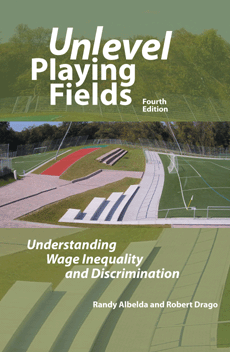
- Edition:
- 4th
- Date of publication:
- August 2013
- ISBN:
- 978-1-939402-05-9
- Pages:
- 193
- Price:
- $36.95
- PREFACE
- ABOUT THE AUTHORS
- PART 1 INTRODUCTION TO WAGE INEQUALITY
- Chapter 1: Two Views on Inequality and Discrimination
- A GLIMPSE AT DISCRIMINATION
- TWO VIEWS FROM ECONOMICS
- WHAT'S AT STAKE HERE
- PLAN OF THE BOOK
- DISCUSSION QUESTIONS
- SUGGESTED READINGS
- Chapter 2: Labor Market Inequality by the Numbers
- INTRODUCTION: LIES, DAMN LIES, AND STATISTICS
- WAGES: THE BASICS OF WAGE INEQUALITY
- The Minimum Wage
- The Rise and Fall of Real Wages
- The Increase in Wage Inequality
- Growing Family Income and Wealth Gaps
- UNEMPLOYMENT TRENDS SINCE THE 1950s:
- PERSISTENT INEQUALITIES
- Measuring Unemployment and Employment
- Unemployment and the Business Cycle
- The Race Gap
- Gender Differences
- THE DISTRIBUTION OF JOBS: NICE WORK IF YOU CAN GET IT
- Industry Differences
- Occupational Differences
- Occupational Segregation
- The Possibility of Discrimination
- SUMMARY AND CONCLUSIONS
- DISCUSSION QUESTIONS
- SUGGESTED READINGS
- PART 2 THE NEOCLASSICAL APPROACH
- CHAPTER 3 The Basics of Neoclassical Economics
- CENTRAL IDEAS: MARKETS AND COMPETITION
- HOW PEOPLE ACT: RATIONALITY, SCARCITY, AND OPPORTUNITY COST
- WELCOME TO THE MARKET: DEMAND AND SUPPLY
- Demand
- Supply
- Equilibrium
- EFFICIENCY, EQUITY, AND THE GOVERNMENT
- Efficiency
- Equity
- Laissez-faire Policies
- BEHIND THE MARKET: THE DIVISION OF LABOR AND COMPARATIVE ADVANTAGE
- SUMMING UP
- DISCUSSION QUESTIONS
- SUGGESTED READINGS
- APPENDIX: A CLOSER LOOK: THE ROOTS OF NEOCLASSICAL ECONOMICS
- Adam Smith and the Wealth of Nations
- David Ricardo and Comparative Advantage
- The Marginalists
- Pareto and Efficiency
- Chapter 4: Work and Wages in the Neoclassical Model
- INTRODUCTION: THE MARKET FOR WORK
- THE DEMAND FOR LABOR: WHY FIRMS EMPLOY PEOPLE
- THE SUPPLY OF LABOR: WHO WANTS TO WORK, AND HOW
- PRODUCTIVE ARE THE WORKERS?
- The Work Decision
- Human Capital
- Household Production
- EXPLAINING WAGE DIFFERENCES
- Firm-specific and General Human Capital
- Compensating Differences and Hedonic Wages
- Inheritance
- UNEMPLOYMENT
- Structural Unemployment
- Frictional Unemployment
- Seasonal Unemployment
- Linking Unemployment and Wages
- The Keynesian Challenge
- THE FAIRNESS OF INEQUALITY: WAGE DIFFERENCES AMONG GROUPS
- DISCUSSION QUESTIONS
- SUGGESTED READINGS
- Chapter 5: Discrimination in the Neoclassical View
- INTRODUCTION: DIFFERENCE AND DISCRIMINATION
- The Inefficiency of Discrimination
- Three Outcomes from Discrimination
- MODELS OF DISCRIMINATION BASED ON PREJUDICE: CONSUMERS, EMPLOYERS, AND EMPLOYEES
- Consumer Discrimination
- Employer Discrimination
- Employee Discrimination
- STATISTICAL DISCRIMINATION
- The Transaction Costs Problem
- The Problem of Statistical Discrimination
- Comparing Prejudice and Statistical Discrimination
- THE MAGIC OF THE MARKET TO THE RESCUE: ENDING DISCRIMINATION
- Ending Discrimination Because of Prejudice
- Ending Statistical Discrimination
- MEASURING WAGE DISCRIMINATION
- How to Measure Wage Discrimination
- How Severe Is Wage Discrimination?
- Problems with Measures of Wage Discrimination
- WHY DISCRIMINATION PERSISTS
- Premarket Discrimination
- Cultural and Biological Differences
- POLICIES AND PRESCRIPTIONS
- SUMMARY
- DISCUSSION QUESTIONS
- SUGGESTED READINGS
- INTRODUCTION: DIFFERENCE AND DISCRIMINATION
- PART 3 THE POLITICAL ECONOMY APPROACH
-
Chapter 7: Work and Wages in the Political Economy
- INTRODUCTION: MORE THAN A PAYCHECK
- WAGE DETERMINATION
- The Labor Theory of Value
- The Role of Customs and Institutions
- Home Production and the Family Wage
- Income Supports and the Social Wage
- MACROECONOMICS: THE ROLE OF UNEMPLOYMENT
- LABOR MARKETS IN CAPITALISM: MOTIVATION AND THE LABOR
- PROCESS
- The Cost of Job Loss: Unemployment Is No Picnic
- The Labor Process: Simplify and Control
- EXPLAINING WAGE DIFFERENTIALS
- Labor Segmentation: Divide and Conquer Everywhere
- The New Labor Segmentation
- Traditions: Faces Filling Places
- SUMMARY
- DISCUSSION QUESTIONS
- SUGGESTED READINGS
-
Chapter 8: The Political Economy Model of Discrimination
- INTRODUCTION: EXPLOITATION, DOMINATION, AND EXCLUSION AGAIN
- DISCRIMINATION IN CONTEXT: WHAT YOU DON'T KNOW CAN HURT YOU
- GROUNDS FOR DISCRIMINATION: ECONOMIC INCENTIVES AND ORGANIZATIONAL ADAPTATION
- Economic Incentives
- Organizational Adaptation: Don't Rock the Boat
- THE DYNAMICS OF DISCRIMINATION
- Discrimination and the Business Cycle
- The Long-Run Dynamics of Discrimination
- WHAT TO DO?
- A Work and Family Bill of Rights
- How Does the Work and Family Bill of Rights Involve and Empower Groups?
- Making Change
- CONCLUSIONS
- DISCUSSION QUESTIONS
- SUGGESTED READINGS

Dollars & Sense
P.O. Box 209
Portsmouth, NH 03802
Phone: (617) 447-2177
Fax: (617) 447-2179
.
© 2024
Economic
Affairs
Bureau,
Inc.