How can we fund universal childcare, Medicare for All, and a green economy while reducing inequality? A new plan shows how taxing wealth and corporate profits more fairly—and cutting wasteful spending—could pay for a fairer, more prosperous economy.
If actions speak louder than words, President Donald Trump has become the world’s greatest booster for renewable energy. The Iran war made the case for moving away from fossil fuels so compelling that a Financial Timesarticle dubbed it “Trump’s New Green Deal.”
For years, Americans were assured that the key to energy security was to produce more oil and natural gas: “drill, baby, drill.” It was a ruse. The shale oil boom turned the United States into a net exporter of petroleum products in 2019 and made oil company executives and wealthy investors even richer. But for working Americans, energy security means something else entirely: it means being able to afford to drive to work, heat a home, and keep the lights on. Doubling down on fossil fuels did zero for them.
Gasoline prices at the pump soared when the bombs started falling on Teheran. By Memorial Day, the average price nationwide was north of $4.50 per gallon compared to $3 before the war. At a time when affordability tops the nation’s political agenda, this could presage a political disaster for Republicans in November’s midterm elections.
When politicians lament “affordability,” they usually pledge a return to lower prices. But in the case of oil and gas, that misses the real issue. Cheaper gasoline can only offer a temporary remission from the affordability affliction, not a lasting cure. As long as consumers remain at the mercy of the price swings of the world oil market, they will never enjoy energy security. The cure for drug addiction is not cheaper drugs; it’s kicking the habit.
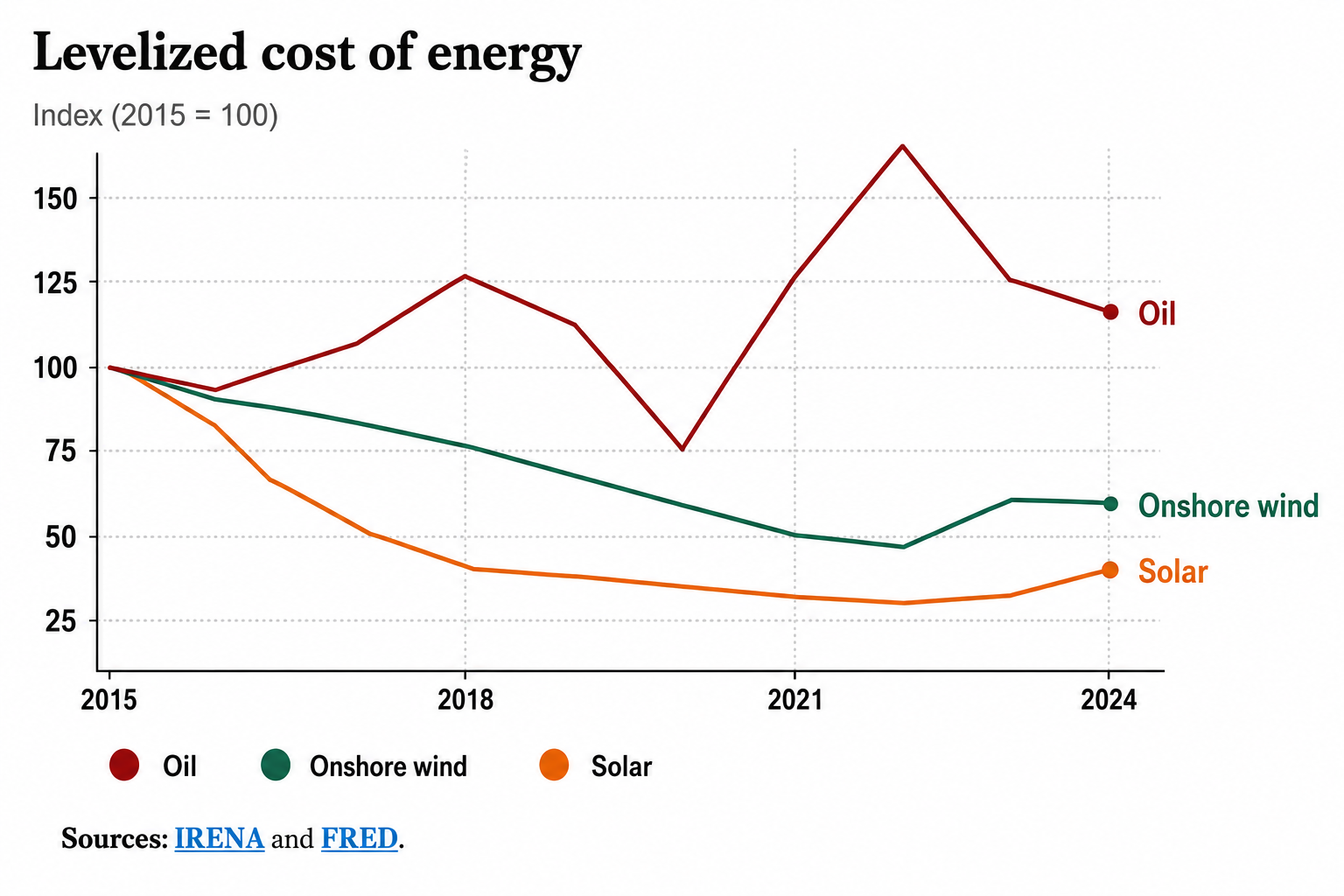
It is illuminating to contrast the price trend for oil to those for solar and wind. The chart below compares their levelized costs (the cost of producing a barrel of oil or a kilowatt of electricity, including capital costs spread over the investment’s lifetime) in the decade before the Iran war. The 2015 costs are set to 100, to show percentage changes in the following years.
Two big differences stand out. First, while the cost of renewables declined substantially, oil prices did not. Second, solar and wind energy costs showed steady trends, whereas oil prices fluctuated greatly, their last peak occurring after the 2022 Russian invasion of Ukraine. The oil price spike triggered by the Iran war is just the latest turn of the screw.
Regardless of whether the United States exports oil or imports it, the price of gasoline at home closely tracks the price of oil on the world market because producers sell to the highest bidder. The connection is a bit weaker for natural gas because U.S. exports are constrained by the country’s capacity to liquefy the gas for shipment overseas in LNG tankers. But that is changing as more LNG export plants are built.
In light of the historical record, it is ironic to hear the Trump administration disparage renewable energy as “unreliable.” Solar and wind power do not have to pass through geopolitical choke points like the Strait of Hormuz, nor are their prices vulnerable to manipulation by petrostates and multinational corporations. It’s true, of course, that the sun only shines in the daytime and that wind speeds vary (though generally they are stronger at night, a handy feature in combination with solar). With recent advances in battery storage, however, the intermittency of renewables is a problem with a solution.
Like solar and wind, the cost of battery storage has been following Wright’s Law, named after aeronautical engineer Theodore Wright, who observed in the 1930s that unit costs in manufacturing generally fall by a constant percentage every time total output doubles, thanks to learning-by-doing. The cost of lithium-ion batteries, for example, declines by 28% with each doubling of global production.
This trend will continue, according to Ramez Naam, one of the few technology analysts who predicted how fast the cost of renewable energy would fall. Innovation diffusion typically proceeds along an elongated S-curve. At first, renewables had to be subsidized, and they gained momentum only slowly. The curve rose steeply when their levelized costs became competitive in new power generation. Now their cost has fallen to the point where investing in renewables can save money, even compared to the operating cost of a fossil fuel power plant alone. Naam expects lithium-ion battery prices to decline another 60% by 2030. After that, next-generation sodium-ion batteries, now at the start of their own S-curve, could drive the cost of battery storage even lower.
Throughout the world, other countries are switching to renewable energy as fast as they can. For Asia, in particular, the Iran war came as a “big wake-up call,” in the words of Faith Birol, director of the Paris-based International Energy Agency. The fact that electric vehicles now account for more than half of all new car sales in China, he notes, is driven primarily not by environmental aims but by the quest for energy security. Demand for rooftop solar systems is surging across Europe. The “Trump tax” has supercharged demand in Africa for Chinese EVs and e-motorbikes assembled there with Chinese parts. Investors are pouring funds into the stocks of Chinese makers of solar panels, wind turbines, electric vehicles, and batteries.
Trump’s bump for renewables is, of course, wholly inadvertent. Here in the United States, his administration clings to the retro fantasy of making fossil fuels great again. He has even committed $2.6 billion of taxpayer money to buying out the offshore leases of energy companies to block the expansion of wind power.
But the political bottom line is that energy security, in the only sense that matters to working people—reliable affordability—is a big deal for Americans too.
The energy security case for renewables comes on top of the environmental case. Although climate change mitigation is sometimes described as a “moral imperative,” it is also rapidly becoming an economic imperative, as seen in the mounting costs of extreme weather events. Once upon a time, the case for renewable energy was about our environmental future. Now it’s about our economic present.
James K. Boyce is a senior fellow at the Political Economy Research Institute at the University of Massachusetts Amherst, and co-author of the forthcoming public policy proposal, “The Fossil Fuel Phasedown: Energy Security and Climate Defense for All,” for Game Changers.
How can we fund universal childcare, Medicare for All, and a green economy while reducing inequality? A new plan shows how taxing wealth and corporate profits more fairly—and cutting wasteful spending—could pay for a fairer, more prosperous economy.
The Trump administration says its new tariffs are aimed at combating forced labor. But the countries with the highest rates of modern slavery are largely exempt, while countries with the lowest rates are being hit with tariffs. So what are the tariffs really targeting?
The Political Economy Research Institute’s new initiative brings together economists and practitioners to develop transformative but practical policies for a fairer, greener, and more democratic economy.