
War Dollars, Care Dollars (and No Sense)
It seems like a good time to compare the running tally of war dollars with the cost of relentless attacks on public care provision in the United States.
Economics textbooks teach you that the London Interbank Offered Rate (known by the acronym "Libor") is the rate at which big global banks make uncollateralized loans to each other. (An uncollateralized loan is backed solely by the perceived credit-worthiness of the borrower.) For years, Libor was considered a fair and efficient market rate of interest, reflecting money market supply and demand conditions, which gave it legitimacy as a benchmark. It is referenced by a wide range of financial products, including mortgages, student loans, and consumer loans, as well as structured financial products such as mortgage-backed securities and collateralized debt obligations (CDOs). However, in the wake of revelations that surfaced beginning in 2012 that became known as the "Libor rigging scandal," the world learned that banks were unfairly setting the Libor benchmark at levels that were more profitable for them.
The manipulation of a benchmark interest rate is so abstract that, even if we recognize it as fraudulent behavior, it is hard for members of the general public to understand who was victimized and how much harm was done to them. Was it just the playboys of high finance picking each other's pockets, or the pockets of their well-to-do clients? Or were they teaming up to pick ours, meaning the bank accounts of average working people? While none of these scenarios are mutually exclusive, my research reveals another dimension of the scandal--that banks may also have been stiffing homeowners by charging inflated Libor rates on their adjustable-rate mortgage loans.
The United Kingdom's Serious Fraud Office (SFO, analogous to the United States' Federal Bureau of Investigation), spent seven years looking into suspicions that a number of big banks were colluding to manipulate Libor for their own benefit. The investigation, which ended in November 2019, led to some mid-level traders who were employed by the banks being sent to jail. But it was disappointing to many observers of the scandal that the SFO did not take any further action with the case. When the investigation closed, we lost the opportunity to learn more about exactly what was afoot and how it was done.
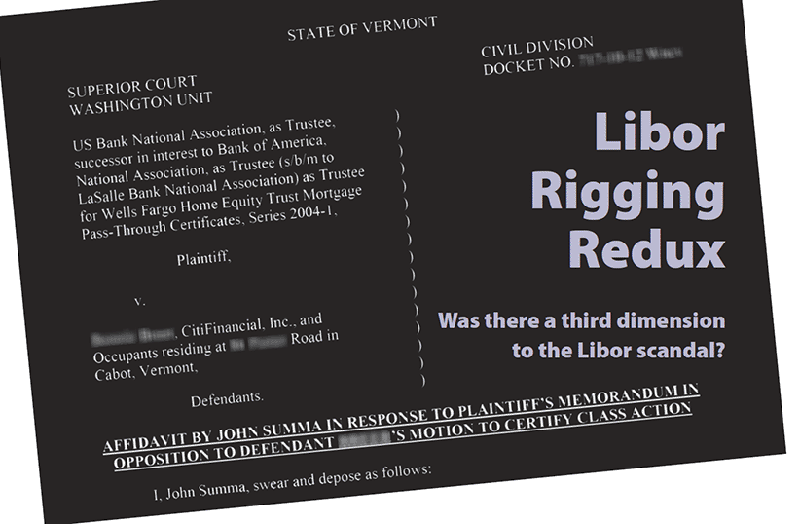
One important underreported dimension to the Libor story, which never became part of the SFO's investigation, is the link between Libor and adjustable-rate mortgage (ARM) loans, many recklessly made to often vulnerable and exploited borrowers in the U.S. mortgage market. The evidence that I amassed as an economic consultant to a Vermont-based independent litigator attempting to bring a class action lawsuit against Bank of America and Wells Fargo was damning enough to cause the banks' lawyers to agree to discuss a potential settlement offer. Due to technical issues with the class action lawsuit, the case did not move forward. So the data and statistical results never ended up being fully presented in court. However, the Libor research suggests that manipulations designed to raise rates on adjustable-rate mortgages may have unfairly transferred billions of dollars from mortgage borrowers to banks, as well to other related parties involved in facilitating such transactions.
Libor was created in 1986 to provide uniformity in the pricing of a burgeoning global derivatives market. From its inception, Libor has remained an "argued" price, writes Alexis Stenfors, former UBS derivatives trader and author of Barometer of Fear, a book about the Libor scandal. It is often a "judgement" by banks, he writes, what banks argue the rate ought to be. It is not and never has been driven by actual supply and demand in an actual market.
Prior to the revelations in the Libor rigging scandal, Libor was entirely unregulated. This meant that conditions were in place for banks to abuse rate-setting in the interest of maximizing profits. Today, the Intercontinental Exchange (ICE) Benchmark Administration is responsible for managing the Libor benchmark and the entire process is regulated by the United Kingdom's Financial Conduct Authority (FCA). Each morning ICE sends the following question to panel banks: "At what rate could you borrow funds, were you to do so by asking for and then accepting interbank offers in a reasonable market size just prior to 11 a.m. London time?" [emphasis added]. The problem with this question is that it appears to be irrelevant to how the Libor panel banks actually function today. As Federal Reserve Chair Jerome Powell wrote in a Wall Street Journal opinion piece, "In essence, banks are contributing a daily judgment about something they no longer do."
Thus, while more governance and oversight by regulators is certainly a good thing, it does little to change the fact that the rates submitted by panel banks are largely not those the banks are actually paying to borrow. So, there is still lots of room for potential tampering. A lawsuit filed in 2019 once again raises questions about manipulation of this important interest rate by banks, for banks.
There were two reported dimensions to the Libor rigging scandal. One was related to Libor "low-balling" by banks (which some Libor panel banks have admitted to doing as part of settlements reached with authorities), which resulted in unfair payments to some holders of derivatives indexed to Libor. This low-balling mainly took place during the early part of the financial crisis, and it reportedly benefited banks as credit-risk concerns mounted. Banks' artificially lowered Libor rate submissions made these banks seem healthier than they actually were, and this would have buoyed their bank shares and lowered the cost of doing business overall because of lower apparent credit risk. They had to have acted as a collusive pack to make this happen, as is now known from some banks' own admissions to regulatory authorities as part of settlement deals (see the "Barclays Settlement as Collusion Prototype" sidebar).
For example, on December 18, 2012, UBS settled a Libor-rigging case with the Department of Justice. As part of the settlement, the bank acknowledged that one of its traders had "requested that his counterpart traders at other Contributor Panel banks make requests to their respective Yen LIBOR submitters to contribute a particular LIBOR submission, or to move their submission in a particular direction (i.e., up or down)." UBS also admitted that this "trader made these requests to his counterpart traders at other Contributor Panel banks on many occasions."
While this is just one example, the same process, assisted by broker "conduits" working with all panel banks, was no doubt at work elsewhere, such as in the setting of the U.S. dollar Libor rate.
For example, economists Connan Andrew Snider and Thomas Youle published an article in the online journal Social Science Research Network that provided statistical evidence of manipulated submissions driven by shared bank incentives. Their statistical findings indicated bank collusion to move rates up and down.
There was also a second dimension to the Libor scandal: Banks' traders of Libor-indexed derivatives got caught working with the banks' Libor rate-submitters to manipulate rates higher or lower. These day-to-day machinations worked in accordance with the trading of portfolios of derivatives and was driven by profit-making (and bonus-seeking) objectives. This type of apparently trader-led manipulation, which evidence shows took place as early as 2005, benefited banks' derivative portfolios, which traders were managing or directing. Fraudulent lowering of Libor by the Libor panel banks, and connivance between bank traders and submitters, would become the basis for lawsuits brought by investors, some of which have been dismissed while others are still working their way through the court system.
While Barclays and some other banks had to pay large fines to settle cases following revelations of wrongdoing in 2012, in the end, these fines were relatively small in relation to what banks typically write off in loan losses each year, which is viewed as a normal cost of doing business. Since then, banks have managed to put the scandal largely behind them and no doubt view this ability to do so as a success, as their annual reports have suggested. And with Libor slated to be discontinued and replaced with another benchmark established by regulators after 2021, this chapter in banker malfeasance will have all but passed.
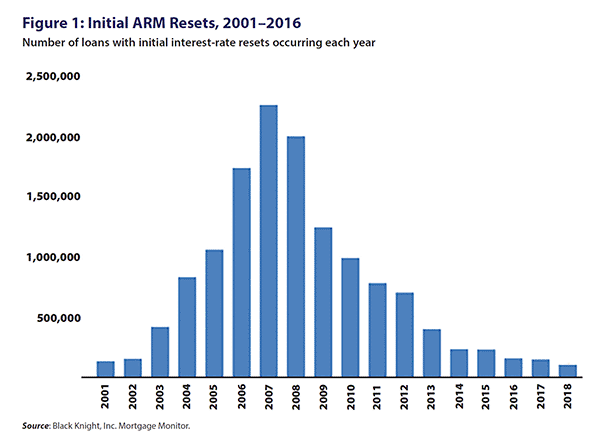
One question that remains unanswered and got little press attention in the reporting of the Libor bank scandal involves reported patterns of unjustified upward movement of the U.S. Libor rate at the end of each month, prior to the subprime mortgage loan crisis that began to roil markets in mid-to-late 2007. Remember, Libor is the benchmark for a whole host of interest rates that affect consumers, especially mortgages. Testimony by traders during investigations and news reports revealed that Libor manipulation could have dated back to as far as 1991. For example, did banks try to profit from setting Libor rates higher ahead of the resetting of adjustable-rate mortgage (ARM) loans using month-end Libor rates. Such rate adjustments would have produced more interest income on a whale-size book of Libor-indexed ARM loans (see figure below) that all banks had a stake in, along with other Libor-indexed loans and consumer credit products. In other words, did banks act as a "pack" given their common stake in mortgage-loan resets at the end of each month? And, if so, was this kind of collusion anything new?
Surging ARM first resets can be seen beginning in 2003 and peaking in 2007. In 2004-2007 an estimated total of at least $1 trillion dollars in loans went through their first resets. First resets typically occur after two years of a fixed-rate period have been applied to the loan. A new rate is then calculated based on a reference rate, such as U.S. dollar six-month Libor. Did banks nudge rates higher to extract more interest income from the estimated $1 trillion of adjustable-rate loans as they reset?
Answers to these questions will probably never be known definitively. The investigations of Libor-fixing were inadequate to begin with and were ended without ever fully exposing the inner workings of the guilty banks involved. The premature end to investigations means no bank was caught red-handed. Yet, as I discovered in my own research, bank fingerprints are all over Libor rates indexed to trillions of dollars in residential mortgage loans. The investigations I conducted as an economic consultant to a Vermont-based independent litigator bringing a class action case against Wells Fargo and Bank of America produced strong evidence of banks' guilt in rigging Libor at month-end, timed to increase profits from adjustable-rate mortgages.
The results of my research I believe convincingly show that banks managed to set higher Libor rates ahead of the resetting of trillions of dollars in mortgages. We know the banks had a motive for such malfeasance. We also know they had the opportunity--and they had the means. Finally, there is very compelling circumstantial evidence that such a crime was committed: The fluctuations that I discovered in the Libor rates used to reset adjustable-rate mortgages appear very fishy indeed. Had there been a full investigation into potential wrongdoing by banks, we could have learned a lot more about such machinations--and banks' modus operandi.
As an economic consultant on the class action case mentioned above, I conducted several studies into the potential for banks to rig Libor rates higher to extract more interest income from accumulating ARM loans in the banking system, which were increasingly making up residential home mortgage loans. I examined the period of January 2004 through August 2007 for evidence of anomalous (that is, not warranted by market conditions and thus suspicious) behavior of the U.S. dollar six-month Libor rates--interest rates widely used to price ARMs at month-end resets, as specified in loan contracts. The potential for extra profits for banks could have been in the billions of dollars.
The results of my statistical tests found a significant Libor upward bias--rates higher than they should have been--just ahead of the monthly resetting of hundreds of billions of dollars' worth of mortgage loans in the period of January 2004 through August 2007. For example, in one of my tests, the second-to-last business day of the calendar month (the day used to reprice most conventional ARM loans) had a pronounced increase of 54 basis point during the period I was examining--about half a percentage point of total extra rate charges applied to millions of resetting loans during the same period. (A basis point, as a measure of an interest rate, is one one-hundredth of one percent.)
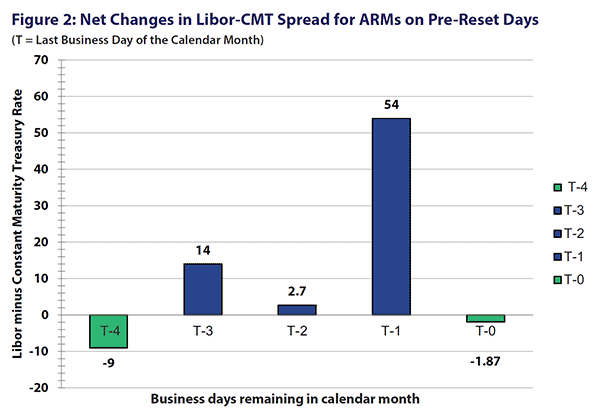
As can be seen in Figure 2, there is a statistically significant anomalous movement in Libor relative to a baseline CMT (constant maturity treasury rate). In other words, the Libor rate was out of line with a comparable market rate, that is--inexplicably high. ("T-1" on the chart indicates one business day before the end of the calendar month, and "T-0" is the last business day of the month. Both days are used for repricing most ARM loans.) The test results indicate that rates were bumped up on or ahead of dates for resetting interest rates for adjustable-rate loans. While it is hard to quantify exactly how much homeowners were overcharged, it is easy to see that loans linked to Libor that were reset in this period would have been relatively overpriced, given that higher rates were applied to them.
This unexplained rise in Libor relative to the baseline CMT rate is pronounced. Yet there is no explanation for such a deviation in Libor rates compared to other similar market rates. Meanwhile, immediately following the month-end reset, tests showed a significant drop in the Libor rate, indicating a correction back toward a non-biased level (see Figures 2 and 3). Further tests revealed Libor itself was on average set higher in the period ahead of reset compared with the period following reset. While the tests don't prove that banks manipulated Libor higher, they do provide additional statistical evidence of possible collusion by banks in raising Libor at month-end in the period prior to the crisis.
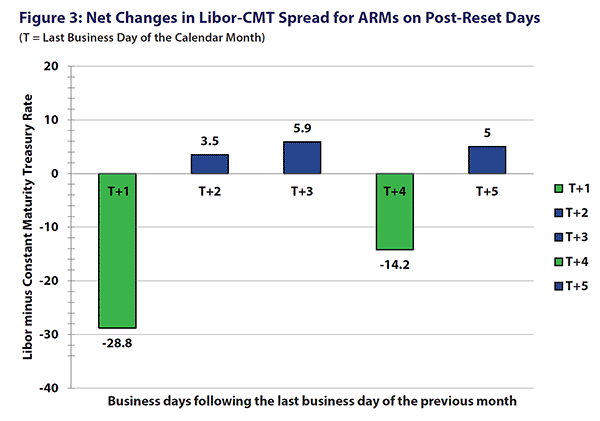
Figure 3 shows that the first day of each new calendar month has a pronounced negative net change in the study period (-28.8). This is a statistically significant anomalous movement in Libor relative to a baseline CMT rate--again, in other words, something fishy is going on compared to what you'd expect. "T+1" indicates one business day after each month-end reset. The data suggest that while the rates rose just before the resets, they were later dropped one business day after the resets. Boosting Libor rates just ahead of, or on, ARM reset days and then dropping Libor quickly, may have enabled banks to maximize the spread between interest received from homeowners with ARM loans and interest paid to investors in bank originated mortgage-backed securities embedded with ARM loans.
Prior to the onset of the 2008 subprime crisis, large volumes of adjustable-rate mortgages were made by both U.S. banks and mortgage companies. These loans have different terms, but most were indexed to the U.S. dollar, six-month term Libor (others were indexed to the U.S. CMT rate). The U.S. dollar Libor rate is quoted daily and is used to determine interest rates on ARM loans that are resetting at specified intervals, such as every six months, after an initial period where a lower teaser rate was offered. According to Thomson Financial, the top underwriters of ARM loans before September 2008 were Bear Stearns, Merrill Lynch, Wachovia, Citigroup, Deutsche Bank, and Bank of America. Three of these banks were Libor panel banks--Citigroup, Deutsche Bank, and Bank of America.
The amount of ARM loans, along with a growing number of them resetting monthly and indexed to Libor, in the period leading up to the start of the global financial crisis, suggest there might have been a shared incentive to move U.S. dollar Libor rates above where they should have been in relation to the Treasury market or other indicators of the price of short-term funding. According to data published by the Federal Housing Finance Agency, total outstanding conventional mortgages reached just over $10.5 trillion by 2007, with conventional (non-subprime) ARM loans at approximately $3.5 trillion. Most of these loans were originated in the years 2002-2006.
Meanwhile, during the same period, according to the Federal Reserve Bank of St. Louis, "there were more than 3 million subprime mortgage loans originated [per year] ... [and] among them, more than 45% were ARMs." Assuming an average of $220,000 per mortgage, approximately $300 billion in subprime ARM loans were made each year. This would put banks' total ARM (prime and subprime) loan "book" as of 2007 at about $5 trillion dollars.
But how, exactly, would the pattern identified in the statistical tests noted above have benefited banks given this loan book? Most of these loans were being charged Libor on an adjusting basis using month-end Libor rates--set by many of the same banks who received interest from ARM loans. The simple fact that the banking system thrives on interest received from its assets (loans), and therefore more interest from higher-than-justified Libor rates on trillions of dollars in ARM mortgage and other Libor-indexed loans, just might be enough of a benefit to entice banks to get in on the take. In addition to the mortgage loans indexed to Libor, trillions of dollars in student loans and other consumer loans were also similarly indexed.
As was made clear in a complaint filed in the United States District Court for the Southern District of New York on October 4, 2012,
Defendants [Libor panel banks] and their co-conspirators engaged in a continuing agreement, understanding, or conspiracy in restraint of trade to artificially fix, maintain, increase and stabilize six (6) month USD LIBOR at or around the first business day of each month and thus maximize their profits and rates of return on LIBOR-Based Instruments owned, sold and traded by them.
With the official end, in late 2019, of the investigations in the Libor manipulation scandal, we will perhaps never conclusively know if senior bank officials and managers were colluding to game interest rates to their advantage ahead of ARM loan resets. But the potential space for action and incentive for multibillion-dollar transfers vis-?-vis interest payments from consumers to banks were there. And the gains would not have been inconsequential.
For example, for each $1 billion in Libor-indexed loans, one extra basis point (one one-hundredth of one percent) submitted by Libor panel banks would have added $100,000 annually in income. While it is not possible to put a precise number on extra profits that might have accrued to banks, it is not too hard to see how much money is potentially involved regarding extra profits. Given that the ARM loans subject to rate inflation totaled nearly $5 trillion dollars, artificially higher Libor rates applied to first and subsequent resets during the 2004-2007 study period would have led to substantial increases in interest income accruing to banks. Just two basis points in extra interest charges on $5 trillion dollars of ARM loans would have generated over $1 billion annually in additional interest income for banks. This is just from ARM loans. The banks had trillions of dollars in other consumer loans linked to Libor. When a former top bank executive source for this article informed a very senior officer currently at a large bank about my data, the banker responded by saying that "banks were probably trying to jack up the rates so that they would be paid more." Cynical comments like this from well-placed insiders suggest it is hardly surprising that wrongdoing in the upper echelons of banking takes place, and that it is to be expected. Indeed, my statistical results indicate that the chance of Libor rates moving higher on loan reset dates had less than a 1% likelihood of happening by random chance. It was more likely that bankers' hands were tipping the scales--and overcharging millions of consumers who ended up paying billions of dollars more to banks in the form of higher interest payments.
Until more transparency is imposed on banks, along with eliminating mechanisms for their continued collusion, the public can expect to see more banker misbehavior in the future.