
When All Else Is Out of Bounds, Zap Labor
From Nixon’s wage controls to today’s interest rate hikes, the fight against inflation has targeted labor.
The Return of an Ancient Treatment for Non-healing Wounds

A few years ago, I published posts about two innovative cancer treatments, The Mouse That Wouldn’t Die (06/06/2014) and Garlic, Cancer, and the Public Funding of Scientific Research (12/09/2018), developed by my husband’s colleague, Zheng Cui. Both treatments succeeded dramatically in the laboratory, and were published in major journals. But neither was patentable and hence potentially profitable, nor acceptable to conventional practitioners. Dr. Cui was unable to raise the necessary millions of private or public money to take them to clinical testing. I ended my posts with a plea for more public funding of scientific research.
For that reason, I am extremely grateful to NBC science reporter Mustafa Fatah for publishing a research piece about another unconventional treatment: blowfly maggots to clean non-healing wounds. The piece includes an interview with me.
During his last months, my husband Tom suffered from pressure wounds, one on his left heel, and one on his butt from sitting too long in a wheelchair. These commonly happen to immobile people, elderly or paralyzed, from pressure on a bony point. With circulation cut off, tissue quickly dies, leaving a deep wound. Bacteria invade, creating a biofilm which prevents healing. Such wounds can be cleaned out (“debrided”) surgically, but that requires cutting healthy tissue and may aggravate the injury.
I’ve always loved insects, those miracles of miniature design. I remembered that for thousands of years, maggots were the recommended way to clean deep wounds. I searched on line for “Maggot therapy, New York City”.
No Luck in NYC, the medical capital of the USA. But in Irvine California I found Monarch Labs, the only US supplier of medicinal maggots, and the BTER Foundation a non-profit devoted to maggot therapy and education. I exchanged emails with Dr. Ron Sherman, the co-founder of both Monarch and BTER, and Dr. Jim Kuo, CEO of Monarch. Maggot therapy turns out to be simple, astoundingly inexpensive, and long ago approved by the FDA (Food and Drug Administration). No professional training or license needed, only a doctor’s prescription, which our family doctor was happy to provide.
For $446, including dressing and overnight Fedex, I held in my hand a three-inch vial containing pinhead-sized maggots crawling on a damp piece of gauze. I assembled the dressing: a kind of stick-on gauze cage to keep the maggots in while letting them breathe. I poked the maggot-gauze into the butt wound and slapped on the dressing.
What could I have thought I was doing? I was conducting a science experiment on a dying man. But Tom was a scientist. In his right mind, he would have loved it. And while the wounds would never heal, cleaning them would reduce the pain and stress of chronic infection.
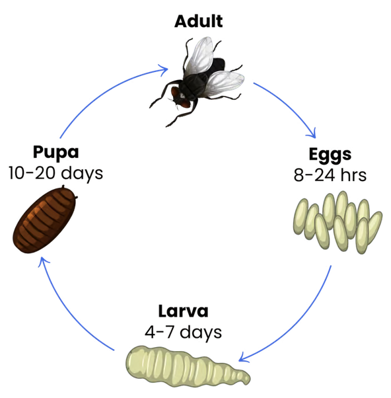
Maggot treatments take less than 48 hours. Maggots don’t bite. They release enzymes to dissolve dead tissue and antibiotics to kill bacteria that might spoil their meal. Then they slurp the resulting puree. By the next afternoon, I could see the maggots, now the size of rice grains, squirming under the gauze. The following morning—Aagh!—the maggots had escaped and were roaming in packs under Tom’s diaper. As the aide tried not to watch, I scooped them up in a gloved hand and threw them in a bucket of hot soapy water. A few had made it out of the bed and were humping their way across the floor in search of a safe place to pupate. When the nurse arrived that afternoon she gasped in astonishment. Most of the wound’s interior was a clean shiny pink.
The next week I repeated the procedure on Tom’s heel. Again, where they weren’t obstructed by dead skin, the maggots cleaned the wound to shiny pink. Another round or two of maggots and the wounds would be totally clean. But Tom was now failing fast. The nurse and I decided not to bother him with the next shipment of maggots. I tossed the vial in the garbage. “Bye-bye, baby maggies. No lunch for you.”
The need for wound treatment is huge and growing as the population gets older. Besides the elderly or non-mobile, non-healing wounds afflict diabetics, people with peripheral arterial disease, and injection drug users— often leading to amputations. Consider some numbers: 4.5% of the Medicare population suffer pressure wounds, that’s about 3 million people. 160,000 people with diabetes undergo amputation each year. And 80% of non-traumatic lower limb amputations happen due to diabetes complications. A recent survey of injection drug users found 87% with non-healing wounds.
Per Monarch labs’ website, they have served over 2000 health care centers in the US, plus a third of their orders go to veterinarians for cattle and horses. Worldwide, over 4000 therapists are using maggot therapy in more than 30 countries, with about 60,000 treatments a year. Yet maggot orders are clearly a drop in the ocean compared to need. Why?
Before antibiotics, surgeons knew about maggots; today most doctors are ignorant. The NBC News piece emphasizes the “yuck factor.” As Dr. Sherman points out, while patients may be ready to endure maggots to save a limb, their doctors are often grossed out. But who needs doctors for a procedure so simple any layperson can do it?
The key obstacle, especially for low-income patients, is insurance. Medicare, Medicaid and private insurers do not reimburse maggot treatment, except possibly as part of a larger clinical package. The FDA must first approve any treatment as “safe and effective,” which it did long ago for maggots. But for a treatment to be reimbursed, it must have a 5-digit CPT (Current Procedural Terminology) procedure code, issued by the AMA (American Medical Association). Or it must have a product code issued by the government agency CMS (Centers for Medicare and Medicaid Services). International maggot supplier BioMonde and BTER Foundation have repeatedly applied to the AMA and CMS for codes, to no avail. (BioMonde gave up and left the US.) So far there are no specific codes for maggots.
The AMA is a legal cartel, established to protect its membership. Hence it would incline to reject innovations that threaten members' livelihoods, like the surgeons who do wound debridement or amputations. This predictable anti-competitive behavior may violate anti-trust laws, though that would be hard to prove. (In 1976-1990 chiropractors successfully sued the AMA for banning them from hospitals. For the first time in decades, the Biden Administration began some serious antitrust prosecutions, only to have the Trump Administration quickly settle or drop the cases.) Some doctors quoted in the NBC piece apparently regard maggots as a dubious last resort for dying patients.
Maggot treatment could help millions of suffering people. But like the potential cancer treatments I wrote about previously, maggots have run up against the powerful monopolistic health industry. In the end, it will take citizen activists, progressive politicians, and a sympathetic press to make promising alternative treatments available. Thanks again, Mustafa Fatah and NBC.

In the contest between Micah Lasher and “AI guy” Alex Bores, is Bores a wolf in sheep’s clothing?
The Numbers Tell an Ambiguous Story The Bureau of Labor Statistics’ Employment Situation for August showed that unemployment rates were
Our November/December 2022 issue has been printed and is going out to print subscribers very soon, and e-subscribers