How Federal Reserve policies, the recession they triggered, and broader political and economic changes weakened workers’ power and helped usher in an era of extreme inequality.
A string of primary victories by DSA-backed candidates and other progressives—from New York to Michigan to Florida—is giving the Democratic left new leverage while putting its ambitious economic agenda back at the center of the party’s debate.
Zapping Labor: The Sharp Rise of Income Inequality Initiated in the Early 1980s
How Federal Reserve policies, the recession they triggered, and broader political and economic changes weakened workers’ power and helped usher in an era of extreme inequality.
In a recent post on Left Hook Economics, I explained how the practices of the Federal Reserve (the Fed) in dealing with inflation have long been designed to zap labor—that is, to weaken workers’ economic power by curtailing economic activity, raising unemployment, undercutting workers’ bargaining strength, and stopping wage growth. I used the extreme experience of the early 1980s to illustrate the point. The Fed pushed interest rates to extreme heights, curtailing economic activity—indeed, creating a recession—that had long-term negative impacts on workers’ wages.
What I failed to point out was that the events of the early 1980s, as part of zapping labor, initiated a sharp increase in the degree of income inequality. The degree of inequality had been relatively low in the post-World War II era, and it continued to decline during the 1970s. But the skyrocketing interest rates imposed by the Fed and the ensuing recession initiated a new era of extreme inequality.
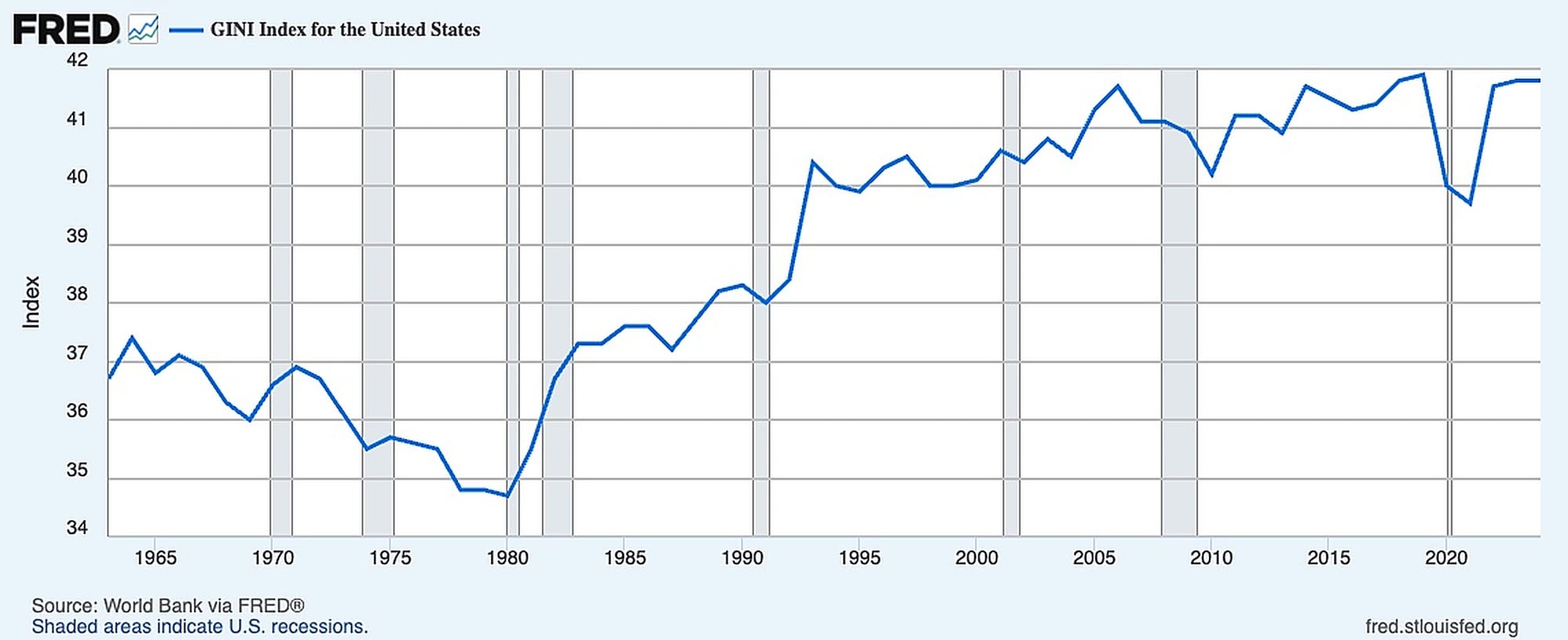
The change is presented in the graph below, which shows the Gini index for household income in the United States, year by year, from 1963 to 2024. The Gini index can range from 0, complete equality, where everyone has the same income, to 100, where all income goes to one person and everyone else gets nothing. For most countries, the Gini index ranges from about 25 (for example, Norway and the Netherlands, with low levels of inequality) to about 55 (for example, South Africa and Colombia, with high levels of inequality).
Source: Federal Reserve Bank of St. Louis
In the United States, during the period shown in the graph, the Gini index was at a low of 34.7 in 1980, but then shot up to 40.4 by 1993, reached a zenith of 41.9 in 2019, and dropped slightly to 41.8 in 2023 and 2024. Clearly, the zapping of labor, by high interest rates and the resulting severe recession of the early 1980s, set in motion a period of great change. It is important to recognize the role of the 1980s in setting off the great rise of inequality and the associated “affordability crisis” in the United States. This recognition highlights the role of conscious policy decisions, rather than attributing the rising inequality to autonomous changes in technology or an inexorable rise of globalization.
Of course, while the Fed’s decisions were very important, they were not alone in bringing about this change. Reagan-era policies of union-busting and weakening workers’ protections played important roles in undermining workers’ power; and the structure of globalization and other factors also contributed.
I should note that I was alerted to this point—of the income distribution shift being set in motion so sharply in the early 1980s—by a presentation at a recent webinar from the Washington Center for Equitable Growth.
Arthur MacEwan is a professor emeritus of economics at the University of Massachusetts Boston.
How can we fund universal childcare, Medicare for All, and a green economy while reducing inequality? A new plan shows how taxing wealth and corporate profits more fairly—and cutting wasteful spending—could pay for a fairer, more prosperous economy.
The Trump administration says its new tariffs are aimed at combating forced labor. But the countries with the highest rates of modern slavery are largely exempt, while countries with the lowest rates are being hit with tariffs. So what are the tariffs really targeting?