
Tax Billionaires, Save Lives: California’s Proposition 40 Is Met With a Heap of Meritless Objections
A one-time tax on the super wealthy is an important step toward greater equality.
In honor of the 250th, capsule reviews of U.S. history books by members of the Dollars & Sense collective.

As the country observes the 250th anniversary of the signing of the Declaration of Independence, many of us are ambivalent about celebrating “Freedom 250” at a time when many of our freedoms are being rolled back, and when we may think that the country’s commitment to those freedoms has often been more aspiration than reality. One of the hallmarks of the Trump era, moreover, is the administration’s efforts to erase critical perspectives on U.S. history. So to observe the country’s milestone, we asked members of the Dollars & Sense collective to do “capsule reviews” of recent critical books on U.S. history. Here we present three reviews, by D&S collective members Zoe Sherman, Suzanne Bergeron, and Bruce Pietrykowski. Happy 250th from the D&S collective! —Eds.
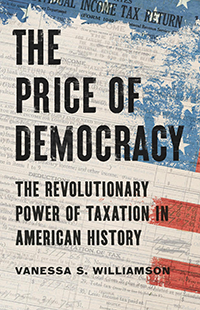
The Price of Democracy: The Revolutionary Power of Taxation in American History, by Vanessa Williamson (Basic Books, 2025)
BY ZOE SHERMAN
Vanessa Williamson, a senior fellow at the Brookings Institution, wants to change the way you (probably) think about the history and culture of taxation in the United States. Although it is not the most common story that gets told, she wants us to see in the history of this country a long tradition of commitment to taxes as a tool of democratic governance. A majority of the population pretty consistently demonstrates a high willingness to pay taxes so long as the burden is fairly distributed, with the rich paying a share commensurate with their resources, so that the community can share high-quality public goods. This broad public support for taxation has consistently been opposed by antidemocratic forces who try to handicap the state’s capacity to levy taxes as part and parcel of their efforts to limit political participation to the wealthy andpowerful.
Williamson presents a grand historical sweep: The first section takes us from the “taxation without representation is tyranny” revolt of the Revolutionary generation to the post-independence suppression by the new United States government of kindred revolts: Shays’s Rebellion in Massachusetts and the Whiskey Rebellion in Pennsylvania. The next section highlights elite Southern slaveholders’ existential fear of both taxes and democracy (even a whites-only pseudo-democracy), the brief flowering of broad-based taxation and public goods during Recon-struction, and then the reclamation of power by the same elite, anti-tax, and anti-democratic class who had lost on the Civil War battlefield. The third section takes us through the 20th century: the New Deal, the creation of a steeply progressive income tax, the Reagan-era and, later, the Gingrich-era revolt against racially inclusive public goods using coded rhetoric of “taxpayers” (assumed white and worthy) and “tax eaters” (assumed Black and undeserving). The big story is illustrated with delicious details and compelling primary source quotations from all sorts of people who took part in these tax and democracy debates over the centuries.
The anti-tax movement of recent generations never achieved any of
its stated aims: there was never a supply-side driven economic boom; there is no downward trend in government spending as a share of GDP; and the bottom 90% of the income distribution actually saw their taxes increase, not decrease. The anti-tax movement did, however, achieve the creation of an American oligarchy. Williamson concludes, with emphasis, “Elites’ fear of taxation is a fear of democracy itself.” People with wealth and power have not wanted those without wealth and power to have a say over tax policy. That is, they do not want democracy.
Zoe Sherman is a political economist and economic historian. She holds a Ph.D. from the University of Massachusetts Amherst, was a professor of economics at Merrimack College for 10 years, and has been a member of the Dollars & Sense collective since 2014.
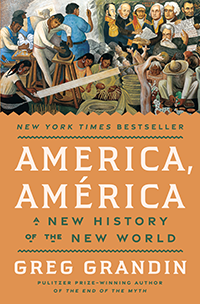
America, América: A New History of the New World, by Greg Grandin (Penguin Press, 2025)
BY SUZANNE BERGERON
When President Donald Trump renamed the Gulf of Mexico the “Gulf of America,” he was probably unaware of the two meanings of the word: one that the United States uses to refer only to itself, and the other that Latin Americans use to refer to the entire New World. In this sweeping account of the 500-year history of the two Americas, Greg Grandin, an historian who teaches at Yale university, examines the competing ideas and practices that distinguish these two meanings.
One of Grandin’s main purposes is to contrast the United States’ history of protecting individual rights and fostering imperial conquest with Latin America’s alternative history of championing social rights and fostering cooperation among nations. The divergence begins well before independence. Influential critics of the horrors of Spanish colonization such as Bartolomé de las Casas provoked a moral reckoning that resulted in official acknowledgement (if not always practice) of the equal humanity and rights of Indigenous peoples in the Spanish colonies. These values were carried forward as revolutionary leaders advocated for legal and institutional structures to guarantee the common good and cross-border solidarity across the Americas. In contrast, early English colonizers arrived to lands scarcely populated, where Indigenous communities had been decimated by diseases carried by earlier European explorers. They declared that these limitless “empty lands” were theirs to exploit, sometimes invoking divine right. By the time of U.S. independence, these ideas had coalesced into an expansionist drive.
Along the way there were attempts by Latin American leaders to draw the United States into a continent-wide cooperative governance structure, but these efforts largely failed. The Monroe Doctrine of 1823 claimed that the United States had a right to intervene against its southern neighbors, ushering in an expansionist hemispheric agenda. President Franklin D. Roosevelt’s Good Neighbor Policy offered a short respite in the mid-20th century, as Latin American nations and the United States came together to fight fascism and foster social democracy. But the Cold War ushered in a period of intense U.S. intervention aimed at installing pro-capitalist, right-wing regimes. The social movements that sprang up in resistance have, however, ushered in the social democratic governments under which most people in Latin America now live.
Grandin ends the book with lessons from this history that might help us to challenge today’s rise of nationalist authoritarianism. These include what we might learn from Latin America on how to successfully counter right-wing extremism by fostering a commitment to social rights, and ways to foster peaceful cooperation among nations.
America, América offers an important corrective to the triumphalist histories of the United States that many of us have been taught. It also highlights Latin America’s rich traditions of social democracy and global cooperation that are often ignored. At a moment when alternatives to U.S. politics feel urgently needed, we might, as Grandin suggests, start looking south.
Suzanne Bergeron is a professor emerita of women’s studies and social sciences at the University of Michigan Dearborn and a member of the Dollars & Sense collective.
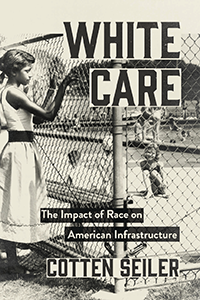
White Care: The Impact of Race on American Infrastructure, by Cotten Seiler (University of Chicago Press, 2026)
BY BRUCE PIETRYKOWSKI
White Care offers up a fresh take on the history of U.S. public infrastructure projects, broadly conceived to include water, sanitation, and highways, but also social infrastructure like schools, parks, and public pools. While the macroeconomic effects of public investments made during the first half of the 20th century are well documented, Cotten Seiler, a professor of American studies at Dickinson College, instead focuses on the racialized intent and impact of public spending on hospitals, schools, water, sanitation, recreation, and highways. He advances the argument that these expenditures represented the material provisioning of care for groups racialized as white to the intentional exclusion and neglect of nonwhite citizens. As a result, he provides evidence for the enduring historical legacy of white privilege in America. Seiler’s account is especially relevant today when politicians, political advisors, and judges are vigorously pursuing the resegregation of American society by race and ethnicity.
The first part of the book provides a deep dive into the social and political impacts of evolutionary biology and the rise of scientific racism embodied in claims of the racial superiority of whites. When translated into public policy this justified whites’ access to “public” goods—first, only Anglo-Saxon whites but later encompassing Jewish, Southern, and Eastern Europeans. For example, though it is likely well-known to many readers of D&S, it bears remembering that the benefits accruing to the predominantly white recipients of the GI Bill were enormous, particularly in terms of lifetime income (via education) and financial wealth (via homeownership).
Over time, scientific racism was largely debunked, although not entirely extinguished. Landmark judicial cases, notably Brown v. Board of Education, together with the Civil Rights movement, resulted in the desegregation of public facilities. The “custodial state” extended care infrastructure to non-whites through, for example, President Lyndon Johnson’s Great Society programs. But, as Seiler notes, the time between the Great Society and the renewed use of IQ-based explanations for racial inequality and the “culture of poverty” was remarkably short-lived. He identifies a connection between neoliberal attacks on government spending and the revival of ideas about racial hierarchy, which helped fuel opposition to spending taxpayer dollars on racial groups deemed undeserving of access to public institutions and social welfare programs.
A timely book, White Care reminds us of the resilience of forces bent on reestablishing racial segregation and, in Seiler’s words, the need to “resist calls to reinstate whiteness as a nation-building essence as in the racially charged summons to ‘make America great again’.”
Bruce Pietrykowski is a professor emeritus of economics at the University of Michigan–Dearborn and a member of the Dollars & Sense collective.