
Disabled People Are the Canaries in the Coal Mine
The disabled community has responded to the adversities they face by organizing for legal rights that protect their autonomy and access to public life. But these rights are increasingly under attack.
Mitt Romney’s call to tax the rich like him renders the Wall Street Journal editors apoplectic.

In mid-December, Mitt Romney, the former Republican governor of Massachusetts, senator from Utah, and 2012 presidential candidate, wrote a New York Times opinion piece entitled “Tax the Rich like Me.”
From the reaction of the Wall Street Journal editors you would have thought that he had thrown a Molotov cocktail wrapped in a paper bag emblazoned with Jean-Jacques Rosseau’s 18th-century slogan “eat the rich.”
What Romney actually wrote was far less inflammatory. He called for “entitlement reform,” meaning means-testing Medicare and Social Security benefits for future retirees. He then added that, “on the tax front, it’s time for rich people like me to pay more.”
Even couched in the Republican orthodoxy of the need for “entitlement reform,” his call for taxing the rich earned him a scolding from the WSJ editors. They began by needling him: “If Mr. Romney wants to pay more taxes, by all means go ahead. Write a check to the Treasury.” Then they schooled Romney and their readers about how the rich are already overtaxed.
Their lecture, however, grossly exaggerated the tax burden of the rich.
A more thorough treatment of the tax data shows that the rich are far from overtaxed. The U.S. tax code is only mildly progressive. The tax rates paid by the rich are not that much higher than the tax rates paid by the rest of us, and in the case of the super-rich, they’re not higher at all.
Here’s how the WSJ editors go about trying to put a shiv in the back of progressive taxation:
What is the share of taxes paid by the top 1%?
The editors first set out to determine what share of total taxes different income groups in the United States pay. Following the lead of the Tax Foundation, a libertarian tax policy center, they only present data for the federal income tax, the one tax in the U.S. tax code that is designed to impose higher taxes on well-to-do taxpayers and lower taxes on less well-off taxpayers. The editors never consider who pays the other federal taxes, let alone who pays state and local taxes.
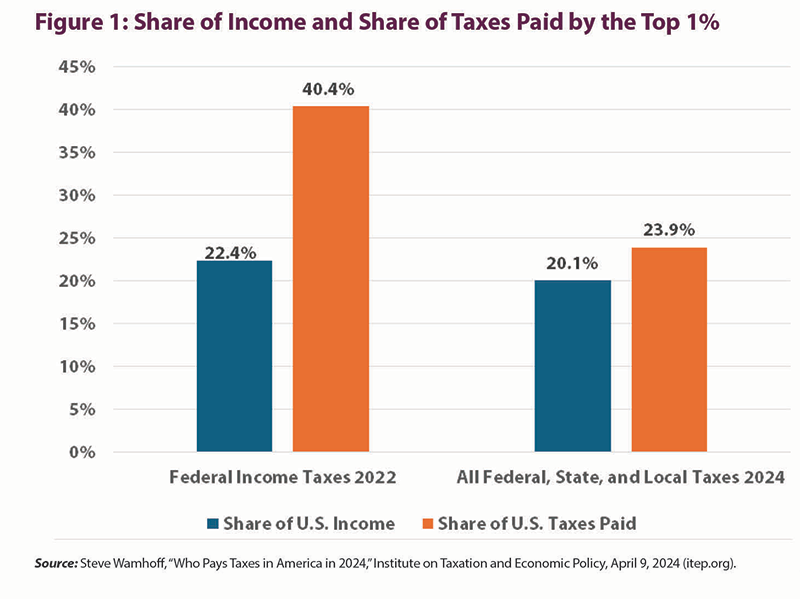
Not surprisingly, the editors found that in 2022 the top 1% of taxpayers paid 40.4% of total income taxes, nearly twice their 22.4% share of income. But the bottom 50%, with a share of income of about 11.5%, paid only 3% of income taxes. While those figures seem to support the editors’ argument, they are consistent with imposing graduated taxes based on a taxpayer’s ability to pay. Afterall, the pretax income share of the top 1% is nearly twice that of the income of the entire bottom 50%.
The editors allow that if they include payroll taxes, which finance Social Security, Medicare, and Medicaid and are taken out of wages, their results “would be less progressive … but not by all that much.”
But why stop with the payroll tax? Let’s look at the entire U.S. tax code. That includes all federal taxes (corporate income taxes, excise taxes, and estate taxes, as well as payroll taxes), which as a group are less progressive than the federal income tax. It also includes state and local taxes (sales taxes, property taxes, and incomes taxes), which are regressive, that is, they take a larger share of the income from low- and middle-income taxpayers than from better-off and rich taxpayers.
n their report, “Who Pays Taxes in America in 2024,” the progressive think tank the Institute on Taxation and Economic Policy (ITEP) estimates that the top 1% of taxpayers pay 23.9% of federal, state, and local taxes combined, not much more than their 20.1% share of the national income in 2024, while the bottom 50% of taxpayers paid about 11.3% of all taxes from their 14.5% share of national income. Those results are substantially different from the editors’ estimates and leave the overall tax rate much less progressive than the editors suggest. (See Figure 1, below.)
What are the average tax rates different income groups pay?
The editors also make the claim that the effective tax rate of the top 1%—how much of their total income they pay in taxes—is already far too high. To make their case, the editors once again look only at the federal income tax. And once again, including other federal, state, and local taxes puts the lie to their claim.
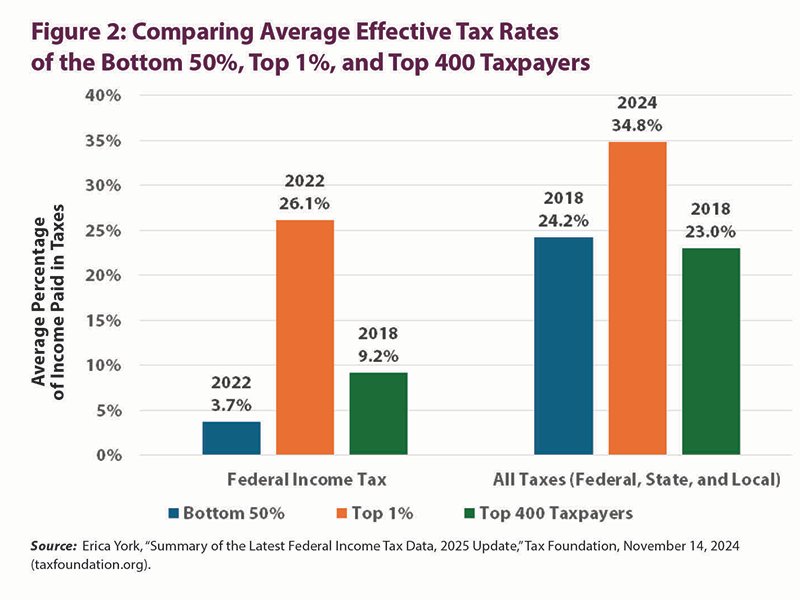
The editors report that the top 1% of taxpayers paid income taxes equal to 26.1% of their income. That was seven times the 3.7% average income tax rate paid by the bottom 50% of taxpayers. While those numbers confirm that the federal income tax, even with its sizeable loopholes, remains progressive, much of that progressivity disappears when we consider the burden of the other federal taxes as well as state and local taxes. The ITEP study estimates the effective tax rate of the entire tax code in 2024. The bottom 50% of taxpayers paid out about 21.0% in federal, state, and local taxes, while the top 1% paid 34.8%. Those rates are far less progressive than the effective federal income tax rates that the editors rely on to make their argument.
With all taxes considered, the progressivity of the U.S. tax code falls short of the progressivity of the tax code of other high-income countries. A 2017 study conducted by the Peterson Institute for International Economics, a nonpartisan think tank, found that U.S. taxation and spending policies did the least to reduce income inequality of any of the 28 high-income countries in the Organization for Economic Cooperation and Development (OECD), and only half as much as Germany, Denmark, Finland, and five other OECD countries. And that was before Trump’s latest round of tax cuts for the rich.
The rock-bottom tax rates of the super rich.
Worse still, “tax progressivity breaks down precisely where it should matter most: at the very top of the distribution,” as the World Inequality 2026 report, which is published each year by the research organization World Inequality Lab, emphasizes. Effective rates often fall sharply for multimillionaires and billionaires.
Inside the top 1%, we find that the super-rich pay a smaller percentage of their income in taxes than the run-of-the-mill one-percenter, turning the tippy top of the U.S. tax code regressive.
In their groundbreaking study, economists Emmanuel Saez and Gabriel Zucman found that in 2018 the effective tax rate (for all federal, state, and local taxes) reached its peak for the top .01% at 33.2% and declined thereafter. The average tax rate of the 400 richest taxpayers was just 23.0% in 2018. That includes the 15.2% tax rate of Jeff Bezos, the owner of Amazon, and the 18.4% rate of Warren Buffett, the chair and CEO of the conglomerate Berkshire Hathaway. The effective tax rate of the richest 400 taxpayers was also less than the 24.2% effective tax rate of the bottom 50% of taxpayers. Finally, in their 2025 study, economists Akcan Bakir and Danny Yagan, along with Saez and Zucman, report that the effective tax rate of the top 400 averaged 30% from 2010 to 2017 but had dropped to the 23.0% rate in 2018 primarily because of Trump’s 2017 tax cut.
“This looks like the tax system of a plutocracy,” was Saez and Zucman’s assessment of the U.S. tax code in their book The Triumph of Injustice. And that plutocratic pattern persists even if we just look at the federal income tax as the WSJ editors insist on doing. In 2018, the income tax collected just 9.2% of the income of
the top 400 taxpayers. (See Figure 2 below.)
There are a number of ways to start to undo this tax injustice. But here are three approaches that would push the super-rich toward paying their fair share of taxes. (You can try out your own tax reforms at taxjusticenow.org, the website for Saez and Zucman’s book.)
In 1960, the richest 400 taxpayers paid over half of their income (56.3%) in taxes. That was more than double the 22.9% effective tax rate of the bottom 50%. In that year the top federal income tax bracket was 91%. Reinstating that top marginal income tax rate for the super-rich would undoubtedly help to undo today’s tax injustice.
But to create a fair tax code we would need to tax the income of the super-rich that goes untaxed due to tax loopholes, which Romney rightly says open up large caverns of untaxed income. One important way to do that is to tax wealth as it accumulates, and not “wait for billionaires to sell their stock,” as Saez and Zucman put it. The Billionaires Income Tax Act introduced by Senator Ron Wyden (D-Ore.), along with Representatives Don Beyer (D-Va.) and Steve Cohen (D-Tenn.), would do just that. It would require taxpayers with more than $100 million in annual income or more than $1 billion in assets for three consecutive years to pay a minimum 23.8% tax on all their income, including all capital gains, whether those gains were realized by selling their assets, or if they continue to hold those assets.
Another, more direct way to require the super-rich to pay their fair share of taxes would be to tax their already-accumulated wealth. In the 2020 presidential campaign, Senators Bernie Sanders and Elizabeth Warren both proposed wealth taxes that would target the super wealthy. The Sanders tax on “extreme wealth” would levy an annual tax on the wealth of households with a net worth of over $32 million and would begin at a 1% rate and reach an 8% rate on wealth over $10 billion. Saez and Zucman estimate that the Sanders wealth tax would have tripled the effective tax rate of the wealthiest 400 taxpayers.
Unlike eating the rich, which would surely make your stomach ache, these types of reforms would give the tax plutocrats indigestion while helping to bring about a fairer tax code.
Sources: Mitt Romney, “Mitt Romney: Tax the Rich, Like Me, New York Times, December 19, 2025 (nytimes.com); Erica York, “Summary of the Latest Federal Income Tax Data, 2025 Update,” Tax Foundation, November 14, 2024 (taxfoundation.org); Steve Wamhoff, “Who Pays Taxes in America in 2024,” Institute on Taxation and Economic Policy (ITEP), April 9, 2024 (itep.org); Jacob Funk Kirkegaard,” “US Government is Worst at Reducing Inequality of All High-Income OECD Countries,” Peterson Institute for International Economics, October 27, 2017 (piie.com); Lucas Chancel et al., World Inequality Report 2026, World Inequality Lab, 2025 (inequalitylab.world); Emmanuel Saez and Gabrail Zucman, The Triumph of Injustice, (W.W. Norton & Company, 2019); Tax Justice Now (taxjusticenow.org); Akcan S. Balkir, Emmanuel Saez, Danny Yagan, and Gabriel Zucman, “How Much Tax Do US Billionaires Pay? Evidence from Administrative Data,” Working Paper 34170, National Bureau of Economic Research, August 2025 (nber.org); “Top Marginal Tax Rates,” SZ2019 Appendix Tables 2019; Emmanuel Saez and Gabriel Zucman, “Don’t wait for billionaires to sell their stock. Tax their riches now,” Washington Post, June 15, 2021 (washingtonpost.com); Senate Finance Committee, “The Billionaires Income Tax,” September 17, 2025 (finance.senate.gov); Emmanuel Saez and Gabriel Zucman, “Statement on Senators Elizabeth Warren’s and Bernie Sander’s Tax Plans,” September 22, 2029 (gabriel-zucman.eu).

