
Another Gift for Corporations--Lower Tax Rates
The Wall Street Journal's Holiday Season Yankee Swap
What do you get the person who already has everything? Congress had the answer for the Supreme Court's favorite person, the U.S. corporation: More of the same--yet more tax breaks. As 2014 drew to a close, Congress passed $42 billion of mostly retroactive tax breaks, the great bulk of which benefitted U.S. corporations.
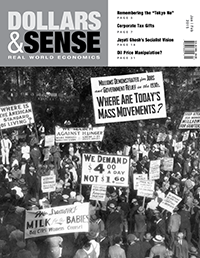
January/February 2015 issue.
But more of the same just doesn't cut it with the Wall Street Journal editors. They're ready to do a gift swap--exchanging yet more corporate tax breaks for lowering the "punishing federal corporate tax rate of 35%."
The U.S. corporate tax code is laden with loopholes and hardly in need of yet more. Nor is there any reason to lower corporate rates, the present gift the editors say we would have bestowed upon U.S. corporations if we really cared.
A $42 Billion Holiday Gift
The WSJ editors are right that there is plenty wrong with this $42 billion package of tax breaks, even at one-tenth the size of the $450 billion package that died with President Obama's veto threat. The package has little to no economic merit. It was made up almost exclusively of "tax extenders"--measures that retroactively extended into 2014 tax breaks that had expired at the end of 2013. Signed into law with less than two weeks left in 2014, the bill didn't "have the shelf life of a carton of eggs," as Ron Wyden (D.-Ore.), the chair of the Senate Finance Committee, put it. And even the Journal editors would not go so far as to argue that tax breaks could improve the past.
If this holiday package of over 50 tax breaks had come with a nametag on it, then it surely would have read "to U.S. corporations." The three largest tax breaks in the bill were: a $7.6 billon "Research Tax Credit" that stretched the definition of research to include retailers developing new packaging for food products; an environmentally friendly $6.4 billion "Renewable Electricity Production Tax Credit" that reduces the taxes owed by commercial and industrial businesses by 2.3 cents per kilowatt for electricity generated from wind turbines; and a $5.1 billion "Active Finance Exception" that allowed subsidiaries of U.S. corporations to defer paying taxes on "passive" income, i.e., financial income earned abroad.
Contrary to the protestations of the WSJ editors, U.S. corporations are hardly hurting or in need of tax relief, whether in the form of tax extenders or lower tax rates. Corporate profits reached 12.5% of Gross National Product (GDP) in 2013, the highest percentage in seven decades. Nonetheless, corporate income taxes continue to contribute just one-tenth of federal government revenues (9.9% in 2013), less than a third of what they provided back in 1952.
A "Punishing" Corporate Tax?
You might think that record high corporate profits and corporations having to pony up a far smaller share of tax revenues than in the past would have put an end to all this talk about a punishing U.S. corporate tax rate. But that's not enough to dissuade the WSJ editors.
Looking at nominal corporate tax rates, they would seem to have a case. The U.S. statutory corporate tax rate of 39.1% (average combined federal and state) in 2013 was in fact the highest of any of the 34 OECD member countries, which include most of the world's large, high-income economies. And the nominal U.S. rate was more than ten percentage points higher than the OECD average of 28.4% (weighted for the size of the economy and excluding the United States).
But any honest comparison of corporate tax rates needs to focus on effective tax rates, the proportion of their total profits corporations actually pay out in taxes. And "statutory tax rates differ but effective tax rate do not," as Jane Gravelle, senior specialist at the Congressional Research Service (CRS), puts it after reviewing the evidence comparing U.S. corporate tax rates with the rates in other industrialized countries. For instance, a study conducted by Price Waterhouse Coopers found that the the effective U.S. corporate tax rate in 2008 was 27.1%, a bit lower than the 27.7% average of the other Organization for Economic Co-operation and Development countries (weighted by GDP).
Why, despite the much higher statutory rates, does the United States have effective corporate tax rates that hardly differ from the OECD average rates? It is riddled with loopholes, reducing the revenues that would have been collected by the corporate income tax by $154 billion in FY2014. The three biggest loopholes:
- Foreign Income: U.S.-based corporations don't pay U.S. corporate taxes on their foreign income until it is "repatriated," or sent back to the parent corporation from abroad. In addition, a foreign tax credit allows U.S. corporations to reduce their U.S. tax liability by whatever they pay out in foreign income taxes.
- Accelerated Depreciation: Corporations are able to write off machinery and equipment or other assets more quickly than they actually deteriorate. The effect is to defer when corporate profits are reported and when corporations pay taxes on those profits.
- Domestic Production Activities: Enacted to keep manufacturers in United States, this deduction has grown to cover roughly one-third of all U.S. corporate activity, including mining, oil extraction, construction, and farming, much of which could never have moved abroad in the first place.
The CRS's Gravelle estimates that these provisions lower the effective corporate tax rate by 4.0, 2.2, and 0.7 percentage points, respectively.
In addition to having effective corporate tax rates no higher than the OECD average, the United States collects less in corporate income tax revenues relative to the size of the economy (2.3% of GDP in 2011) than the OECD (3.0% of GDP in 2011). That has been true ever since 1997, as the United States opened up tax loopholes, while other OECD countries offset the revenues lost to lowering corporate tax rates by "broadening the base" (eliminating loopholes).
Nor is there is credible evidence that lower corporate tax rates will substantially boost economic growth. In her report for the CRS, Gravelle asks if cutting the U.S. corporate tax rate from 35% to 25% would lead to significant gains. "Estimates suggest a modest positive effect on ... output," she concludes, "an eventual one-time increase of less than two-tenths of 1% of output." In addition, because the tax cut would affect output by attracting foreign investment, she finds that most of this small output gain would not add to national income because returns to capital imported from abroad belong to foreigners.
What to Do About Corporate Taxes?
Corporate tax reform needs to concentrate on eliminating corporate tax breaks. A combination of forces has reduced U.S. corporate income tax receipts as a share of GDP and below the OECD average. Since the 1980s, the share of business profits subject to corporate income tax declined steadily as more and more businesses were organized as partnerships and "pass through" businesses. These businesses--including large law firms and giant hedge funds?are able to reduce their tax burden by paying individual income taxes on their profits instead of corporate income taxes. At the same time, ever-wider corporate tax loopholes have reduced the taxes collected from corporations as a share of GDP and have allowed highly profitable corporations to pay little or no taxes. Even the Journal editors are willing to trade eliminating "as many special tax breaks as possible" for "locking in lower rates." (See box.)
Even the Journal editors are willing to trade eliminating "as many special tax breaks as possible" for "locking in lower rates." But there is no reason to accept that kind of deal. First of all, a "revenue-neutral" swap of fewer tax breaks for lower rates could improve the efficiency of the corporate tax system, but it would do nothing to accomplish the editors' goal of reducing the tax burden on U.S. corporations, since it would collect the same amount of revenue from corporations (in the aggregate). Beyond that, corporations should not be rewarded with lower tax rates for giving up loopholes that for far too long have allowed them to shirk their responsibility to toward maintaining the economy that has been so profitable for them.
A good place to start is to close down the special treatment of foreign sources of income. U.S. corporations are holding more profits overseas than ever before. In 2013 the companies listed in the Russell 1000 index of U.S. corporations held more than $2.1 trillion of indefinitely reinvested foreign earnings not subject to U.S. corporate income tax, according to the research firm Audit Analytics. The conglomerate General Electric Co. (GE) topped the list, with a whopping $110 billion parked abroad. GE paid no corporate income taxes in the years from 2008 to 2010 and in 2012 still paid just 8.2% of its profits in corporate income taxes.
Repealing the deferral of taxes on profits earned abroad by U.S. corporations' foreign subsidiaries would substantially increase revenues from the corporate income tax, and at the same time reduce the incentive for corporations to move jobs and assets to low-tax countries. Limiting foreign tax credits to offsetting tax liability only on income earned in the same country would recover yet more tax revenues. Together these reforms would add about $70 billion a year in tax revenues, and increase U.S. corporate income-tax revenues to about 2.63% of GDP.
Matching the OECD average of 3.0% of GDP would yield nearly $150 billion. That's not the deal the editors were looking for in return for shutting down as many tax loopholes as possible. But the additional revenues could fund the House Progressive Caucus proposal to spend $1.3 trillion over 10 years for job creation through measures such as infrastructure investment, aid to states to hire public employees, and tax credits for working families and for green manufacturers, which would benefit corporations along with the rest of us.
Now that would be a Yankee swap more to our liking.